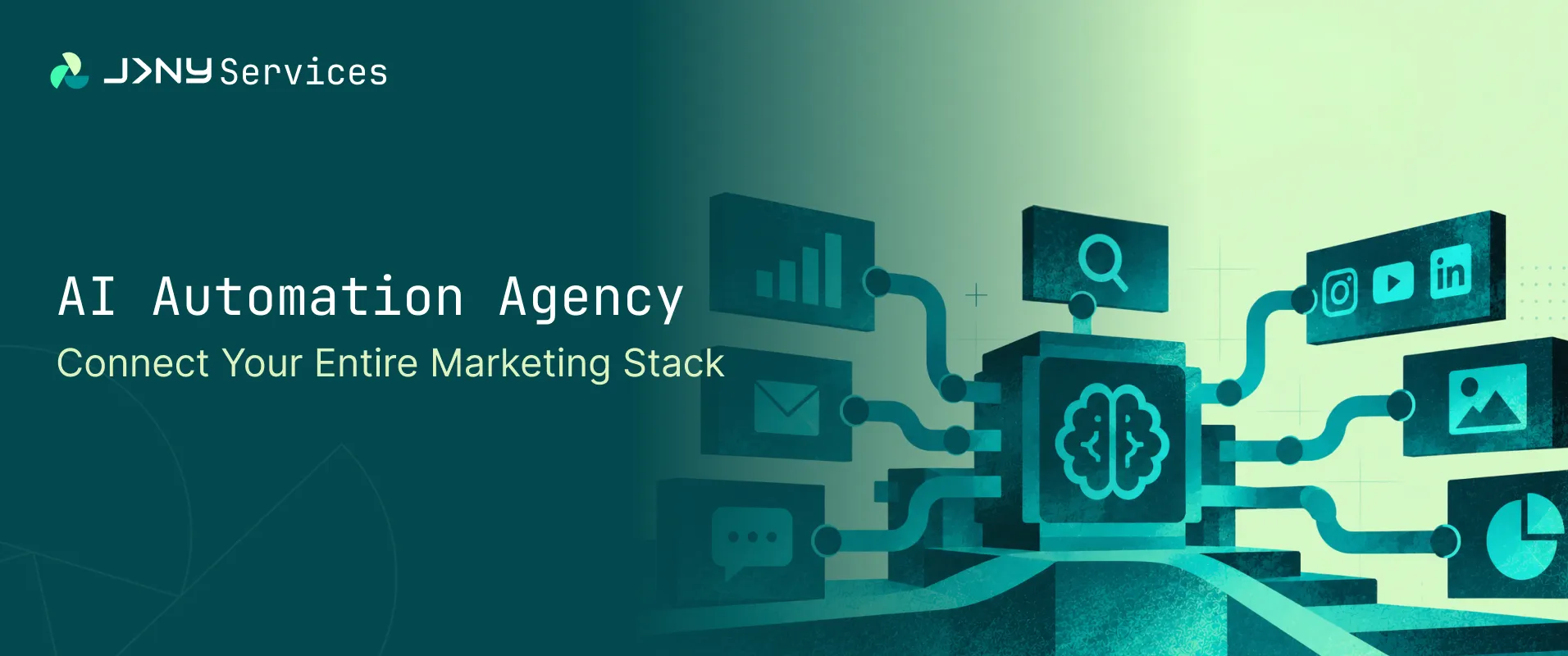
Ask a marketing team why pipeline dipped last month and see who gets to open the ad platform first, who goes for the CRM, who hunts for the analytics export and who finds out that the email numbers are somewhere else entirely. Twenty minutes later there are five open tabs with three slightly different answers.
Everyone here is doing a good job, but the information is in too many places for any one person or tool to see it all at once. We see this problem every week, and that's why the conversation around AI agents for business is turning to questions like "what can it see?"
Here is how we think about it as an agency: where the stack fails, what an AI could do if it could see, and what work remains for humans to do.
Why Is the Modern Marketing Stack So Fragmented?
How the stack ended up this way
Nobody builds the marketing stack on purpose. There are so many marketing use cases to cover, and the stack grows like a tangle of vines with every new hire, promotion, or quarterly planning meeting. Paid media needs managing, so the team adds a DSP. Sales wants more lead info, so they procure a CRM. Someone senior wants better reporting, so analytics tools get added to the stack. Then there is email, SEO software, a landing page builder, call tracking, and an enrichment tool someone signed up for in 2023 that nobody got round to cancelling.
Tools are added to the stack one by one, justified by the business need they serve. All the same, every new tool adds complexity, requiring new logins, definitions, and often owners. In the fragmented stack, it is hard to reconcile conversions across channels, and different areas of the business have conflicting numbers. Paid media claims a higher conversion rate, while sales has a more realistic assessment, and the web team has their own perspective.
What fragmentation costs
Time, obviously. It takes too long to extract and tally figures for the weekly marketing meeting, requiring excessive data crunching by whoever maintains the stack. But the opportunity cost of this poor process is even higher. If it takes that long to prepare for the meeting, the discussion is likely to be a turf war between departments about whose performance is better, instead of a constructive conversation about the business. The worst part is that decisions get made based on outdated information.
The most pressing issue in the marketing-sales alignment usually happens when the lead qualifies for the next step in the sales process. The lead score in the ad platform may suggest the prospect is a good fit, but in the CRM, they appear to be an average lead, and in the sales rep's notes, they may not be a fit at all. By the time the sales rep calls, another month of budget has been wasted.
What Does It Mean for AI to Work Across Your Marketing Stack?
AI working across your marketing stack means an AI system can read, compare (plus, where permitted, act on) data from your ad platforms, CRM, analytics, website, email and sales tools together, not just one at a time or what one pastes into a chat.
Two abilities hide in that sentence, and we think it's worth keeping them separate.
- Reading across systems : This is the easier half. An AI that can see ads spend, CRM stages and web behaviour together can answer questions no dashboard can, e.g. which campaigns drove deals that actually closed.
- Acting across systems : This is the harder, riskier half. Drafting a budget change, tagging a record or routing a lead are actions, and actions need permissions, review and a log of what happened. Most teams should expect to live on the reading side for a good while before trusting anything on the acting side. We did.
Why Context Is the Real Opportunity for Any AI Automation Agency or Marketing Team
Capable models are easy to come by now. Context is what's scarce.
Give a model no access to your accounts and it will give you competent, generic advice. Give the same model your numbers and it can say something specific, checkable and occasionally uncomfortable. Intelligence isn't the difference. What the model is allowed to look at is.
McKinsey's State of Marketing Europe 2026 report has numbers on the gap. Ninety-four percent of European marketing organisations haven't advanced their gen AI maturity. The 6 percent who have report efficiency gains of 22 percent and expect 28 percent within two years. The same report warns that gen AI efforts risk becoming isolated pilots without solid data and technology foundations, and names an integrated martech stack as one of the things that enables them.
Read that last part twice. The leaders aren't ahead because they found a cleverer model. Their systems are connected well enough for any model to be useful.
What Is MCP? A Marketer's Guide to the Model Context Protocol
The Model Context Protocol, or MCP, is an emerging open standard for connecting AI applications to tools and data sources. In plain terms, it gives an AI one consistent way to ask a system, "what do you hold, and what am I allowed to do with it?"
Before something like this, every pairing of AI tool and business system needed its own custom connection. WorkOS calls this an N×M problem: five AI tools and ten systems could mean fifty separate integrations to build and maintain. A shared protocol brings that down to roughly one connection per system and one per AI tool.
Anthropic introduced MCP in late 2024. OpenAI, Google and Microsoft have since adopted it, and in December 2025 it moved to the Linux Foundation, so no single vendor owns it. WorkOS reports around 97 million monthly SDK downloads by early 2026.
Two caveats, because they matter. The same WorkOS overview says there's still no standard audit trail for enterprise use, so teams building on MCP end up inventing their own logging. And a protocol is only plumbing. It won't fix messy data or unclear ownership.
How MCP Could Connect AI to Your Ads, CRM and Analytics Data
This section is written in "could" terms. The details change by platform and vendor, and none of it describes a product.
Starting read-only
A sensible setup connects an AI application to an ad account, a CRM and an analytics property through MCP connections that can only read. It can pull spend, lead records and session data. It can't change a thing. That alone gets rid of the copy-and-paste step, because the AI reads live data rather than a spreadsheet exported on Tuesday.
What stays hard
Connecting doesn't solve matching. If a lead's source in the CRM says "paid social" and the ad platform calls the same campaign something else, the AI has to reconcile the two, and it only manages that if naming conventions and UTM tags were consistent to begin with. Teams with tidy tracking get far more from connected AI than teams without it. That's an annoying reason to fix your tracking first, and it's still the right one.
What Connected Marketing Could Look Like in Practice
Picture a Monday where the weekly summary is already waiting. It doesn't only list spend and clicks. It tells you one campaign's cost per lead jumped, that the leads it brought in are stalling at the first sales call, and that a quieter campaign is quietly producing most of the opportunities that reach proposal.
A good marketing team already tries to produce that summary by hand. What changes is who assembles it and how long it takes.
Where business process automation fits
A lot of marketing operations is repeated handoff: reports built from live sources, new leads checked for duplicates and routed with their campaign history, budget alerts when spend runs ahead of plan, tracking checks that catch broken UTMs. Business process automation has covered parts of this for years. Connected AI could stretch it further, into the jobs that used to need someone to look at several tools and make a call. None of it is glamorous. All of it eats hours.
What This Looks Like Inside a Lean Marketing Team
Everything above has been written in "could" terms. This part isn't. We recently added MCP into our internal marketing stack and created our own, and the easiest way to explain it is a recent report on a video campaign we run for one of our clients.
Over four weeks it spent $140.45 and drove 8 conversions, which works out at $17.56 per conversion. The report pulled straight from the account and, within seconds, showed where the gaps were. The content network had taken $65.49, nearly half the spend, and delivered no conversions at all. YouTube produced all 8 conversions on $74.96, about $9.37 each. Tablet had the best conversion rate at 16.13%, with 5 conversions from $65.05, while desktop and connected TV brought views and clicks but no conversions.
It flagged the softer signals too. Click-through rate was low at 0.11%. Impression share sat around 10%, and average frequency was 1.31, so the problem was limited reach rather than ad fatigue.
Viewers were also dropping off early. Quartile completion fell from about 6.6% at the first quarter to 3.8% at the end, even though cost per view stayed low. Two creatives stood out against the rest, and a few had no impressions at all.
The recommendation was to move budget away from what wasn't working and into what was, so we stop wasting it. Google Ads and Meta Ads reports and recommendations now come back in just a few seconds.
Sample campaign daily report from one of our client video campaigns:
Video Campaign Performance | |
|---|---|
Metric | Performance |
| Avg. Frequency | 1.31 |
| Impressions | 79,393 |
| Clicks | 87 |
| Cost | $140.45 |
| Conversions | 8 |
| CTR | 0.11% |
| Avg. CPC | $1.61 |
| Cost per Conversion | $17.56 |
| Conversion Rate | 9.20% |
| Impression Share | 10.0% |
| Views | 7,669 |
| View Rate | 9.66% |
| CPV | $0.02 |
| Video played to 25% | 6.6% |
| Video played to 50% | 5.1% |
| Video played to 75% | 4.3% |
| Video completed (100%) | 3.8% |
Quartile columns show the share of viewers who watched 25%, 50%, 75% and 100% of the video.
It also gives us a daily report. Without going into the ads and analysing everything manually, which takes about an hour a week, we were able to do it on a daily basis, understanding the gaps and fixing what was required. So there were no setbacks or holdbacks, no extra hire, and the ads ran smoothly. In a lean team, that adds up to roughly two to four hours saved every day, and multitasking doesn't feel that heavy any more. JRNY believes in making everyday tasks quick and automated, with one human overseeing it and getting results, which leaves us time to focus on what matters.
There is one limit, and it's worth saying plainly. We can't rely on the recommendations a hundred percent. It's always good to have an agency or a marketing person overseeing it, so you don't end up changing things you didn't want to. The good thing about our MCP is that it asks for permission before publishing anything. Ads data has no commercial context, and a campaign can look weak on paper for a reason only someone close to the client would know. Nothing changes in an account until a person has read the recommendation and said yes.
How Connected AI Can Surface Campaign Patterns and Budget Inefficiencies
People are bad at spotting patterns that span several tools. That's where a connected system should earn its keep.
The video report above is a small example. Reading the network split next to the device split showed that spend was leaking into a placement that never converted while a quieter one did the work. Each dashboard on its own would have shown a respectable click-through rate on the content network. Side by side, the numbers told a different story.
Other things a connected system could surface are slow-burn campaigns that look poor after two weeks and strong after ten, which short reporting windows miss, and lead response times that quietly decide whether a lead converts regardless of which ad sent it. It could also catch two campaigns bidding on overlapping audiences and competing with each other, or whole audience segments eating budget without producing a single qualified lead.
Each finding is a prompt, not a verdict. An AI can say "this looks inefficient". Someone who knows the commercial context decides whether it's wasted spend or a deliberate brand play.
Why Linking Ad Performance to CRM Outcomes Matters for B2B Performance Marketing
Ad platforms report on what they can see: impressions, clicks, form fills. In B2B that's the first page of a long story. Sales cycles run for months, several people are involved in every deal, and the person who clicked an ad in March might become revenue in September.
A B2B performance marketing agency, or an in-house team doing the same job, only learns what's working when ad data and CRM outcomes sit side by side. Without that link, optimisation drifts toward whatever the platform can measure quickly: cheap leads, high click-through, volume.
Connecting the two moves the conversation from leads and clicks to pipeline and revenue. A campaign with an expensive cost per lead may be producing the best deals. A cheap one may be producing contacts nobody ever calls back. Those are different strategies, and you can only choose between them with the linked view.
It also takes some heat out of the oldest argument in marketing. When marketing and sales look at the same data, the lead quality debate becomes a discussion about specific campaigns.
How AI Agents for Business Can Analyse Creative Performance Across Channels
Creative analysis is hard to do by hand because the data sits in different places under different labels. A headline in one platform, a video in another and an email subject line somewhere else rarely get compared on equal terms.
AI agents for business that can read across channels could group creative by theme rather than by platform. In our own video report, two creatives clearly outperformed the rest while a few never served at all. That sort of split is exactly what's easy to miss when you're scrolling through thirty ads one at a time.
What the analysis can and can't tell you
It can show which messages, formats and audiences are associated with results. It can't say why. A pattern might come from the message, the timing, the audience, or plain luck on a small sample. Treat what it finds as hypotheses to test, and keep the testing disciplined.
Why Human Strategy Matters More in an AI-Connected Stack
The more AI can process, the more the human parts matter.
Positioning is still a human call. A model can summarise what competitors say. It can't decide where you should be different. Commercial context is the same. A dip in leads during a quarter when sales is deliberately chasing larger accounts isn't a problem, but the AI only sees a dip. Someone in the room knows the plan.
Creative judgement and accountability sit with people too. Data says which ad worked. It rarely says what to make next, and when a decision goes wrong, "the model suggested it" won't satisfy a client or a board.
Marketing leaders should expect their own role to shift. Less time goes on assembling numbers and more on interpreting them. That's a better use of senior people, as long as the team still understands how the numbers were put together.
What to Look for in an AI Automation Agency or AI Automation Partner
If a team decides it wants outside help, from an AI automation agency, a business process automation company or a performance marketing agency adding automation, a neutral checklist beats a polished pitch. These are the questions we'd ask ourselves.
- Data access : Which systems will it connect to, and how? Does it start read-only? Who holds the credentials, and what happens when someone leaves?
- Permissions and security : Can access be limited to specific accounts and tasks? Are changes to connected tools reviewed before they take effect? Microsoft's security team has documented attacks where an approved tool's description was quietly altered after sign-off, so this isn't theoretical. And is there a log of what the AI did and why?
- Human oversight : Which actions can run unattended and which need approval? Who signs off on budget changes, external messages and anything touching financial records?
- Commercial understanding : Does the provider understand your sales cycle, or only the technology? Can they explain a recommendation in business terms? Do they ask about tracking and data quality before they propose tools?
A provider who can answer those plainly is worth a conversation. For a sense of how AI and automation work gets scoped, and why some businesses prefer one integrated partner to several separate suppliers, those pages set out our approach.
Why Connected Data Could Become a Marketing Team's Biggest Advantage
Models will keep getting cheaper and more alike, so the edge is unlikely to come from which one a team picks. It could come from how well a business connects its data, software and decision-making, and from how clearly its people know what to do with what the connected view shows them.
FAQs on AI Automation Agency
1. What does it mean for AI to work across a marketing stack?
It means an AI system can read data from ad platforms, CRM, analytics, email and other tools together, rather than one at a time, so it can answer questions that span them, such as which campaigns led to closed deals.
2. What is MCP, and why does it matter to marketers?
MCP (Model Context Protocol) is an emerging open standard that gives AI applications a consistent way to connect to tools and data. For marketers, it could reduce the custom work needed to link AI to ad platforms, CRMs and analytics.
3. Does connected AI replace a performance marketing agency?
No. It changes where the time goes. Reporting and pattern spotting get faster, while strategy, creative direction and commercial judgement stay with people.
4. Is it safe to give AI access to ad accounts and CRM data?
It can be, with care. Start read-only, limit permissions to what each task needs, review any change to connected tools, and require human approval for spending, external messages and financial records.
5. Why does linking ad data to CRM outcomes matter in B2B?
Because B2B sales cycles are long, ad platform metrics like clicks and form fills say little about revenue. Linking them to CRM outcomes shows which campaigns produce pipeline, not just leads.
6. Where should a team start?
With tracking and data quality. Consistent campaign naming, working UTMs and clean CRM stages make any connected AI far more useful. Then pick one repetitive job, such as weekly reporting, and connect it end to end.