Understanding the automotive buyer journey is the starting point for any marketing strategy that actually works. Whether your buyer is a consumer researching their next vehicle or a Commercial Director evaluating a fleet management platform, the way they make decisions has changed fundamentally, and most automotive marketing has not caught up.
Think about the last time you made a big purchase. You likely did not walk into a showroom, let a salesperson guide you through the options, and leave with a decision. You researched. You Googled. You asked AI. You watched reviews. You compared across multiple tabs, read what other buyers said, and only spoke to a supplier once you largely knew what you wanted.
That behaviour now defines the overwhelming majority of automotive buyers, B2C and B2B alike. According to Cox Automotive's 2025 Car Buyer Journey Study, 1 in 4 new-vehicle buyers used AI tools during their research, and buyers who completed most steps digitally saved an average of 41 minutes at the dealership and reported higher satisfaction. For automotive companies, whether you are a dealer, OEM, subscription mobility provider, or automotive SaaS business, this shift changes everything about how marketing needs to work.
The Old Automotive Buyer Journey vs the New One
A decade ago, the car buying process was largely dealer-led. Buyers came in with limited information, relied heavily on the salesperson for guidance, and visited multiple dealerships before deciding. Today, that discovery process has moved almost entirely online. By the time a buyer arrives at a dealership or contacts a vendor, the decision is often already made, or very nearly so.
The same shift applies in B2B automotive. A fleet manager evaluating telematics software, a dealer group assessing a new DMS platform, a mobility startup comparing marketing agencies: all of them follow the same pattern. They research independently, form preferences, and arrive at supplier conversations with their own shortlist already assembled. According to 6sense's 2025 Buyer Experience Research, the pre-contact favourite wins the deal roughly 80% of the time, which means shortlist formation, not sales conversations, is where most B2B deals are decided.
What has driven this change? Access to information is the obvious answer, but it is more specific than that. Buyers now have peer reviews, expert comparisons, video walkthroughs, real ownership experiences, and pricing data, all from their phone, any time of day. The information asymmetry that once gave dealerships and vendors a structural advantage has been almost entirely reversed.
For automotive companies, this is not something to resist. It is something to build for. The brands winning today are the ones that have made themselves part of that independent research journey, not the ones trying to gate information and force buyers into conversations before they are ready.
How Automotive Buyers Research Today
Understanding how buyers actually research is the foundation of any effective automotive marketing strategy, and the answer is more varied, and more B2B-relevant, than many automotive companies realise. Search engines remain the starting point for most buyers. 92% of automotive shoppers use digital channels to research before buying, and the majority of those searches happen on mobile. But search is not the whole story.
Video has become one of the most powerful research tools across the automotive category. 75% of auto shoppers say video content influenced their shopping behaviour and purchase decisions, and over 60% visited a dealership or supplier website after watching a vehicle or product video. For automotive companies not investing in video content, this represents a significant gap in their buyer journey presence, and it applies equally to SaaS product walkthroughs and fleet outcome videos as it does to consumer test drives.
Social media has moved well beyond advertising. Among recent purchasers, 64% cite social media as the most influential channel during the awareness phase, with platforms like LinkedIn, Instagram, and YouTube functioning as digital discovery spaces where buyers form early impressions before ever engaging directly.
Reviews are decisive across both B2C and B2B. Consumer buyers use Google, DealerRater, and Edmunds. B2B buyers use G2, Capterra, and LinkedIn peer recommendations. An automotive brand or SaaS platform with poor review management is being eliminated from consideration before a single conversation has taken place.
AI is entering the picture rapidly. Cox Automotive's 2025 study found that 1 in 4 new-vehicle buyers used AI tools during their research, with early adopters reporting higher satisfaction and faster processes. For B2B automotive buyers, AI-assisted research is growing even faster, with buyers using tools like ChatGPT and Perplexity to shortlist vendors, compare platforms, and summarise reviews. Appearing in those outputs is now part of what effective automotive demand generation looks like.
The Comparison Stage: Where Decisions Are Really Made
The comparison stage is where the automotive buyer journey gets complicated, and where most automotive companies lose buyers without ever knowing they were in contention.
By the time a buyer reaches this stage, they have already narrowed their options significantly. They are not comparing the entire market. They have assembled a shortlist of two or three options and are now asking one question: "Which of these should I trust?"
At this stage, messaging matters enormously. Automotive companies that lead with feature lists and technical specifications are answering the wrong question. The buyer does not just want to know what the product does. They want to know what it will do for them specifically. A fleet operator comparing telematics platforms wants to understand how much operational downtime the software has prevented for comparable businesses. A consumer choosing between two similarly priced SUVs wants to know which other owners in their situation have been happiest with.
Transparency has become a competitive advantage here. Cox Automotive found that trust in dealers has recovered substantially, driven almost entirely by greater pricing transparency, honest information, and digital tools that remove ambiguity. The dealerships and automotive companies gaining trust are the ones making it easier for buyers to get what they need, not harder.
One practical reality that automotive companies often underestimate: buyers are comparing the experience of researching each option, not just the product itself. If your website is slow, confusing, or thin on content, that experience sends a signal. If a competitor's site answers the buyer's questions clearly and makes it easy to take the next step, they win the comparison before any direct interaction has happened. For B2B automotive SaaS businesses especially, where sales cycles are long and multiple stakeholders are involved, website credibility is often the first filter applied.
The Validation Stage: Trust Before Commitment
Before a modern buyer commits, whether that means booking a test drive, requesting a demo, submitting a finance application, or signing a procurement contract, they go through a validation stage. This is where trust signals become the deciding factor.
For consumer car buyers, validation typically involves checking recent reviews, confirming pricing consistency, looking at the brand's social presence, and sometimes reaching out informally through forums or owner communities. They are looking for anything that might disqualify their preferred choice.
For B2B automotive buyers, the validation process is more structured but follows the same logic. Case studies from businesses they recognise, testimonials from comparable clients, clear explanations of contract scope, and evidence of genuine industry expertise all reduce the perceived risk of making a decision. At this stage, a buyer who cannot find enough reassurance will not choose you. They will choose the competitor whose digital presence makes the decision feel safer.
This matters commercially. Buyers who report a high-quality research and purchase experience consistently show higher satisfaction, greater loyalty, and faster time to close. The quality of the journey, including how easy it was to find the right information and how trustworthy the brand felt throughout, is worth more to buyers than the lowest price. Automotive companies competing purely on price are leaving both revenue and retention on the table.
The Role of Content Throughout the Automotive Buyer Journey
Content is the mechanism that connects your brand to buyers at every stage of the automotive buyer journey. But most automotive companies treat content as a single-stage tool, either top-of-funnel awareness material or bottom-of-funnel sales collateral, when effective content needs to do active work throughout.
During the discovery and research stage, buyers need educational content that helps them understand their options, form their criteria, and start eliminating alternatives. This includes comparison guides, explainer videos, honest product reviews, and SEO-optimised content that answers the questions buyers are actually typing into search. The goal here is not to sell. It is to be useful enough to earn a place on the shortlist.
During the comparison stage, buyers need specificity. Case studies, outcome-led product pages, transparent pricing information, and detailed FAQs that address real concerns about reliability, support, running costs, and what happens when things go wrong are what keep your brand in the running. Vague, aspirational marketing copy actively hurts performance at this stage. Buyers are looking for evidence, not slogans.
During the validation stage, buyers need reassurance. Testimonials from real customers, consistent and accurate information across every channel, responsive communication when questions arise, and a website that is clear and easy to navigate on mobile are the trust signals that tip a buyer from consideration to commitment. A single friction point at this stage can undo weeks of positive brand impression.
The most effective automotive content strategies are built around this full journey, not just one stage of it. At JRNY Services, we help automotive and mobility businesses map their content to buyer behaviour, identifying where they are losing buyers at each stage and building systems to close those gaps.
Aligning Your Marketing with How Automotive Buyers Actually Behave
The core implication of everything above is that automotive marketing strategies built around interruption, including cold outreach, generic advertising, and pressure-led in-dealership tactics, are becoming structurally less effective. Not because buyers are harder to reach, but because they have become better at filtering out marketing that does not respect the way they want to buy.
Cox Automotive's research confirms that buyers who completed most steps online reported the highest satisfaction levels and saved an average of 41 minutes at the dealership. Supporting digital self-service is not just a convenience feature. It is a conversion strategy.
Aligning with modern automotive buyer behaviour means being present at the research stage, not just at the point of intent. SEO content, video, social media, and thought leadership that shows up when buyers are still forming their views is what earns a place on the shortlist.
It also means making comparison easy, not difficult. Clear pricing information, transparent product details, and honest content that acknowledges tradeoffs builds more trust than polished marketing that avoids hard questions.
Removing friction from the validation stage matters just as much. A website that loads quickly on mobile, reviews that are recent and genuine, consistent information across all channels, and a clear next step are the things buyers are quietly judging throughout the entire process.
And increasingly, it means optimising for AI and LLM discovery. With 1 in 4 new-vehicle buyers already using AI tools, and B2B adoption growing faster, appearing in AI-generated recommendations is becoming as important as appearing in traditional search results.
The Journey Has Already Started
The modern automotive buyer is not waiting for your marketing to reach them. They are already researching, comparing, and forming preferences, largely without you. By the time they reach out, the decision is often close to made.
The automotive companies that win in this environment are the ones that have built a presence throughout the journey, not just at the end of it. That means investing in the right content at the right stage, building trust through transparency rather than pressure, and ensuring that every digital touchpoint, from the first search to the final form submission, reflects a brand that understands its buyers and makes their decision easier.
If your current automotive marketing strategy is built around pushing buyers to engage before they are ready, it is worth asking a simpler question: what would it look like to be the brand they find and choose during their research?
JRNY Services helps automotive and mobility businesses build marketing systems aligned with the full buyer journey. Contact us to start with a pipeline and content audit.
FAQs
1. How do automotive buyers research cars and platforms today?
Modern automotive buyers are overwhelmingly digital-first. 92% use digital channels to research before purchase, spending significant time across search engines, video platforms, review sites, social media, and manufacturer or vendor websites.A growing proportion are beginning their journey by asking AI tools to summarise options and compare alternatives. By the time most buyers visit a dealership or contact a vendor, they have already formed a strong preference, which is why visibility during the research phase, not just at the point of contact, is where marketing decisions are actually made.
2. What is the automotive buyer decision process?
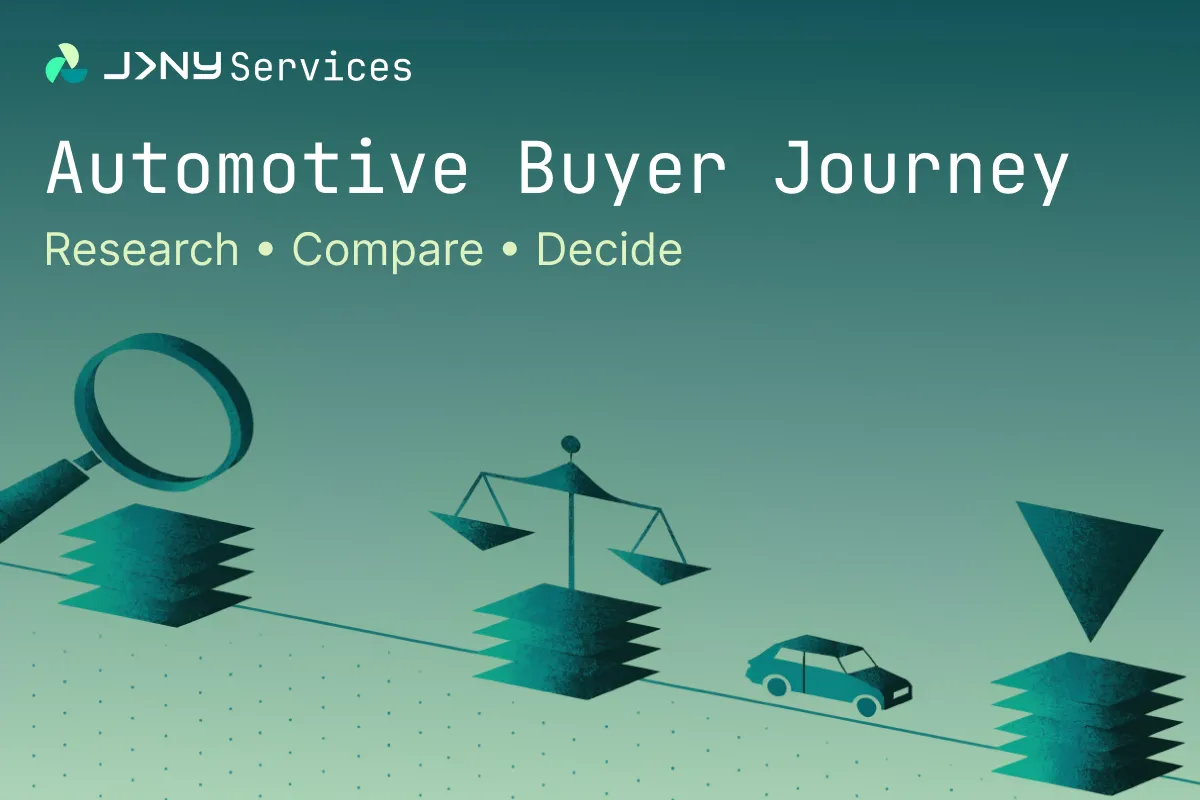
The automotive buyer decision process typically moves through four phases: discovery (becoming aware of options), research (gathering detailed information), comparison (narrowing to a shortlist and evaluating trust and fit), and validation (confirming their preferred choice before committing). The majority of this process now happens independently, online, before any direct engagement with a dealership or vendor.For B2B automotive buyers, this journey often involves multiple stakeholders, including fleet managers, finance directors, and procurement leads, each conducting their own research before the group reaches out to a shortlist of suppliers.
3. What does the B2B automotive buyer journey look like?
The B2B automotive buyer journey follows the same broad pattern as consumer buying behaviour but with added complexity. Business buyers evaluating fleet software, dealer technology, or mobility services conduct independent digital research, often across a group of stakeholders with different priorities.They use search, LinkedIn, peer networks, review platforms, and increasingly AI tools to research and compare options. According to 6sense's research, the pre-contact favourite wins 80% of the time, meaning marketing that reaches B2B buyers during the research phase, through educational content, thought leadership, and a credible digital presence, is what determines whether you appear on that shortlist at all.