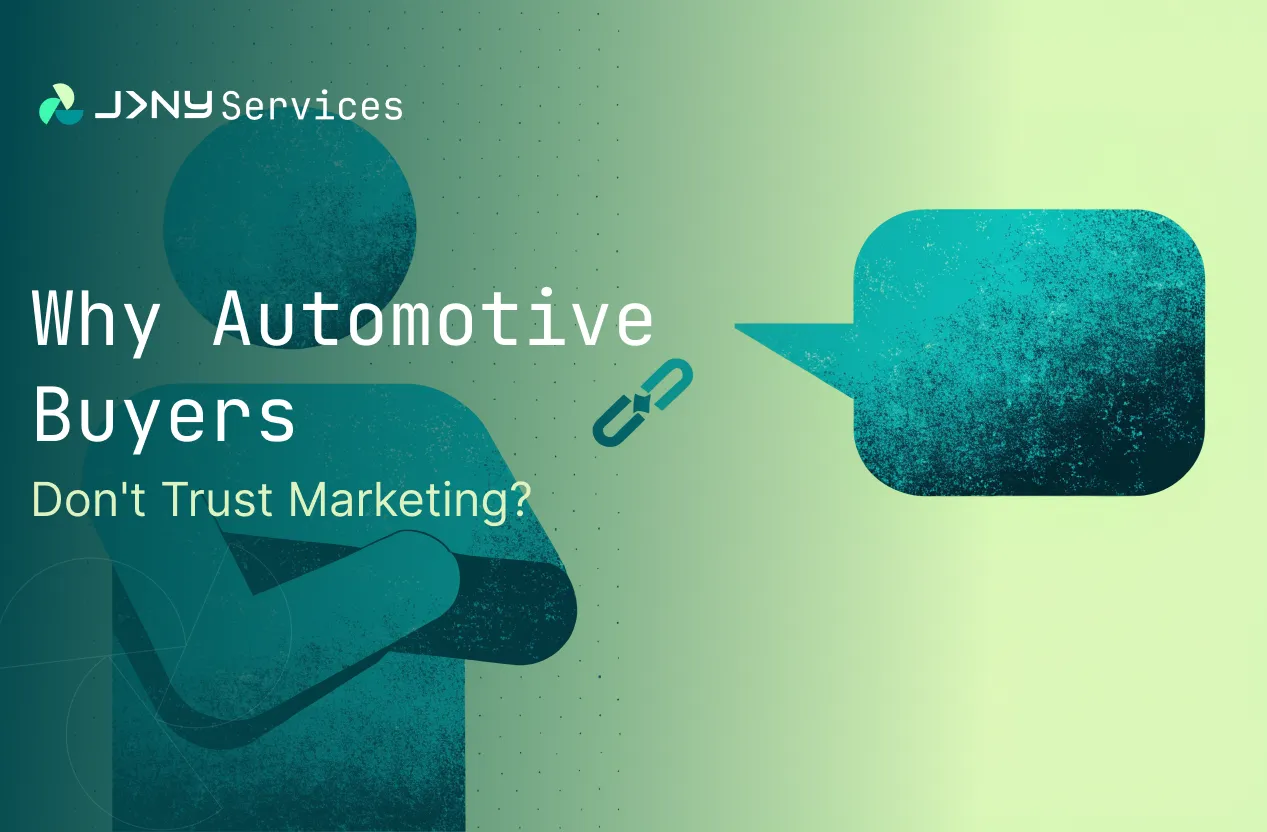
The automotive industry operates on a paradox. It produces some of the most technologically advanced, highly engineered, and deeply complex products in the world, and yet, the marketing used to sell these products is often viewed with overwhelming skepticism.
Whether you are a SaaS founder trying to sell a fleet management platform, or a dealership principal launching a new consumer car subscription service, you are facing the exact same headwind: a profound lack of buyer trust.
Understanding why automotive buyers don’t trust marketing requires looking past surface-level metrics and examining the fundamental psychology of the modern buyer. Today, automotive buyer behavior online is defined by defensive research. With 92% of car buyers researching online before ever making contact with a vendor, the balance of power has completely shifted. Buyers are aggressively filtering out glossy, brand-driven marketing in favor of peer-driven information, authentic reviews, and hard operational data.
If your marketing strategy relies on outdated sales tactics, vague promises, and aggressive calls-to-action, you are not just failing to convert leads, you are actively damaging your brand's credibility.
The Historical Baggage: Why Car Buyers Don’t Trust Dealership Marketing
To fix a broken marketing strategy, you first have to understand the historical context of the industry. For decades, automotive sales - both B2B and B2C, were defined by high-pressure tactics, opaque pricing models, and an extreme asymmetry of information. The salesperson held all the cards, and the buyer knew it.
The "Only About Us" Syndrome
This historical baggage is exactly why car buyers don’t trust dealership marketing today. Even as the industry has modernised, much of the marketing collateral still feels inherently self-serving.
A critical error identified by industry experts is that too much car dealership marketing content is entirely brand-centric rather than customer-centric. As highlighted in insights regarding the reasons why auto dealer content fails, creating content that is "only about your car dealership" or your software's specific features completely misses the mark. Modern buyers do not care how long your company has been in business or how many awards your software has won; they care exclusively about whether you can solve their specific, immediate pain point without ripping them off.
Overuse of Buzzwords and Vague Claims
One of the most common mistakes in automotive marketing content is the heavy reliance on meaningless buzzwords. When an operations director reads that a new telematics platform is "revolutionary," "synergistic," or "disruptive," their immediate reaction is skepticism.
In a sector defined by heavy physical assets, compliance laws, and safety regulations, vague claims are a massive red flag. They signal to the buyer that the marketing team wrote the copy without actually consulting the engineering team. If you cannot explain the value of your product using precise, industry-specific operational language, the buyer will assume you lack the technical depth required to be a reliable partner.
The B2B Reality: Fear of Risk and Failure in the Buyer Mindset
While B2C consumers fear overpaying, B2B mobility buyers fear catastrophic operational failure. This fear of risk is the primary reason why automotive marketing messages fail to resonate in the commercial sector.
Lack of Real Operational Understanding Imagine an industry professional evaluating a new predictive maintenance software for a fleet of 500 commercial vans. This is a multi-million-pound decision. If the software fails, vans break down, delivery SLAs are breached, and the company loses major contracts.
When a marketing campaign targets this business with a generic eBook titled "10 Ways to Improve Fleet Efficiency," it feels insultingly basic. It demonstrates a complete lack of real operational understanding. You don’t need basic efficiency tips; you need to know exactly how your API integrates with their legacy CAN bus data, and what your guaranteed server uptime is.
Bridging the Knowledge Gap
To build true automotive brand trust marketing, your content must prove that you understand the gritty, unglamorous realities of the buyer's day-to-day life. You must speak the language of compliance, risk mitigation, and total cost of ownership (TCO). When your marketing proves that you understand the complexity of the problem, the buyer naturally trusts that you are capable of delivering the solution.
The Shift Toward Peer-Driven Information
Because buyers naturally distrust corporate marketing, they have built their own defensive research mechanisms. The modern automotive purchase journey is highly decentralised.
As noted by industry analysts exploring why car brands have a long road ahead, an overwhelming 92% of buyers utilise independent online research to form their opinions. This shift toward peer-driven information means that buyers are actively verifying your marketing claims before you even know they are in your sales funnel.
The Rise of the "Dark Social" Review
The most critical conversations about your brand are happening in places your marketing team cannot easily track. Buyers are consulting private Slack communities, dedicated subreddits, and third-party review platforms before they ever visit your homepage. According to TrustRadius B2B buying statistics, nearly 100% of buyers now want to self-serve all or part of their buying journey, relying heavily on independent reviews.
Furthermore, Think with Google's automotive insights show that the average vehicle shopper engages with multiple digital touchpoints purely to validate claims made by the dealer. If your content marketing strategy does not proactively address these external conversations by publishing transparent, unfiltered customer success data, you leave a massive credibility void for your competitors to fill.
Automotive Digital Marketing Trust
If your website promises "seamless integration," but a user on an industry forum complains that your onboarding process took six chaotic months, the forum wins. Peer validation will always override corporate messaging.
Therefore, a successful automotive content marketing strategy cannot just be a broadcast mechanism; it must be an aggregation of social proof. You must proactively bring the peer-driven validation onto your own platforms, leaving no room for the buyer to doubt your claims.
Automotive Marketing Trust Building Strategies
Reversing the trust deficit requires a fundamental shift in how you produce and distribute content. You must transition from being a "promoter" to being an "educator."
Why Case Studies Matter More Than Slogans
In the automotive and mobility sector, a single, deeply detailed case study is worth a hundred generic blog posts. Trust building strategies in the automotive industry rely heavily on the concept of "show, don't tell."
When writing a case study, do not gloss over the difficulties. A highly credible case study acknowledges the initial friction of the onboarding process, details the specific technical hurdles your team overcame, and then presents the hard, verifiable data of the final outcome.
Instead of a slogan saying, "We maximise dealership efficiency," publish a case study titled: "How we helped Dealer X reduce administrative processing time by 22% using automated compliance workflows." This level of granular transparency signals confidence and operational maturity.
How Trust is Built Over Time
Trust is not generated by a single clever ad campaign; it is built through relentless consistency. How dealerships can build trust with online buyers, and how B2B SaaS companies can win over buying committees, comes down to establishing a long-term "Minimum Viable Presence" of authority.
You must consistently publish technical whitepapers, host webinars with real operational experts (not just sales reps), and provide transparent pricing guidelines. When a buyer researches your brand over a six-month sales cycle and sees that your messaging is consistently educational, data-driven, and highly transparent, the protective walls of skepticism begin to come down.
Stop Selling, Start Educating
The days of winning market share through sheer volume of advertising are over. The modern automotive buyer is highly educated, intensely skeptical, and terrified of making a poor operational or financial decision.
If you want to know why automotive buyers don’t trust marketing, just look at the content most brands are producing. It is vague, overly aggressive, and entirely self-serving. To win in this new era, you must flip the script. Stop trying to sell your product, and start proving your operational expertise. Build a digital ecosystem rooted in transparency, data, and peer validation. When you prioritise buyer education over brand promotion, you don't just generate leads, you generate trust.
Frequently Asked Questions
1. Why do automotive buyers distrust marketing so much?
Decades of high-pressure tactics, opaque pricing, and information asymmetry have left a lasting legacy. Even today, most automotive marketing remains brand-centric, focused on company history and awards rather than solving real buyer problems. This has pushed buyers toward defensive research, with 92% now vetting vendors independently before making any contact.
2. What do buzzwords actually do to your brand?
They signal that your copy was written without genuine operational input. In a sector defined by compliance, safety regulations, and heavy physical assets, terms like "revolutionary" or "industry-leading" are immediate red flags for technical buyers. Vague language implies you lack the depth to be a reliable partner.
3. Why are B2B automotive buyers so much harder to convince?
Because they're not afraid of overpaying, they're afraid of catastrophic operational failure. A fleet management software decision can involve hundreds of vehicles and multi-million pound contracts. If it fails, SLAs get breached and major accounts are lost. These buyers need proof of reliability and technical compatibility, not generic efficiency content.
4. Why is one detailed case study worth more than dozens of blog posts?
Because it proves competence through verifiable data rather than promises. A case study that honestly acknowledges onboarding friction and presents measurable outcomes is far more persuasive to a cautious buyer than any slogan. It shows you understand the problem deeply enough to have actually solved it.
5. What does "educate instead of sell" actually look like in practice?
A: It means replacing feature broadcasts with operational proof. Concretely: technical whitepapers written by engineers, webinars hosted by practitioners (not sales reps), transparent pricing benchmarks, and honest case studies that include the messy parts. The goal is to make a buyer feel informed and safe, not sold to.
6. Is your digital presence building trust or creating friction?
In the high-stakes automotive sector, credibility is your strongest commercial asset. JRNY Services combines deep sector focus with integrated strategy to help you replace vague buzzwords with proven, operational authority. to discover how a trust-first digital ecosystem can help you shorten sales cycles and win over cautious buyers.