Key Takeaways (TL;DR)
- The In-House Reality: Building an internal team provides deep cultural alignment and brand control, but scaling companies often struggle to afford the highly specialized technical skills (SEO, CRO, Automation) required to win in the modern mobility market.
- The Agency Trap: Traditional agencies offer rapid execution and technical breadth, but generic providers often fail automotive clients by applying "cookie-cutter" B2B strategies that lack critical industry nuance.
- The Cost Comparison: A true financial analysis reveals that the fixed costs of a fully comprehensive in-house team (salaries, software, training) far exceed the scalable, outcome-driven costs of a specialized partner.
- The Winning Framework: A hybrid marketing model for automotive companies, pairing internal brand leadership with outsourced technical execution, is the most reliable, cost-effective way to achieve sustainable long-term growth.
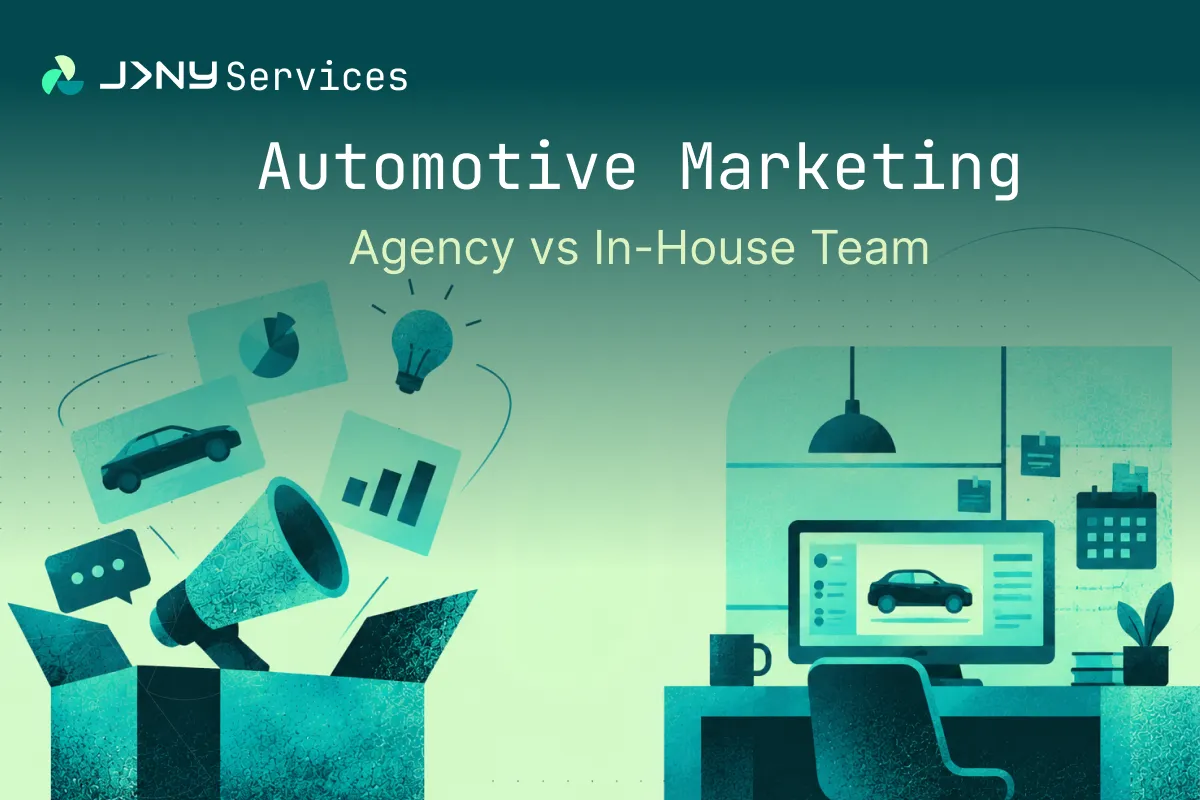
Automotive Marketing Agency vs In-House Team: Which Works Best for Automotive Brands?
For founders, industry leaders and dealership principals in the mobility sector, hitting the first major growth ceiling is a defining moment. You have a proven product, whether it is a revolutionary fleet management platform, a new car subscription service, or a specialized dealership CRM. You have initial market traction. But to scale sustainably, you need a powerful, consistent engine for generating demand.
This realization inevitably leads to one of the most debated questions in business growth: automotive marketing agency vs in-house team, which route actually delivers the best return on investment?
If you choose to hire internally, you face ballooning fixed costs and the terrifying reality of managing a discipline you might not fully understand. If you choose an external partner, you risk handing the voice of your brand over to a team that doesn't understand the complex nuances of the automotive industry.
To break through the growth ceiling, automotive companies must move beyond the binary choice. By objectively comparing cost vs. capability, exploring where traditional models fail, and embracing new hybrid approaches, leaders can build a growth engine that scales without breaking the bank.
The Appeal and Reality of the In-House Marketing Team
Building an internal marketing department is often the default aspiration for many scaling businesses. It feels safe, controllable, and deeply integrated into the daily life of the company.
Deep Control and Cultural Alignment
The primary advantage of an in-house team is their proximity to the product. As highlighted in discussions comparing consultant vs agency vs in-house automotive structures, an internal employee lives and breathes your company's unique value proposition. They sit in on product development meetings, they understand the exact tone of the CEO, and they have a consistent, unwavering dedication to your long-term strategy. For established, mature companies with massive, highly predictable budgets, this level of control is incredibly valuable.
Why In-House Teams Struggle with Niche Expertise
However, for scale-ups and SMEs, the in-house model quickly shows its limitations. Modern automotive marketing services require a vast, highly technical skill set. To execute a proper digital strategy today, you need an SEO specialist, a technical copywriter who understands mobility software, a conversion rate optimization (CRO) expert, and a data analyst.
You cannot hire all of these skills in one person. When businesses attempt to hire a "marketing unicorn", a single mid-level manager expected to handle everything from Google Ads to long-form technical whitepapers - burnout is inevitable. The in-house team inevitably struggles with niche expertise, resulting in slow adaptation to changing industry trends and an over-reliance on basic, low-impact tactics.
The Traditional Automotive Marketing Agency: Speed vs. Substance
When internal hiring becomes too expensive or too slow, leaders naturally look to outsource. Partnering with an automotive digital marketing agency is generally viewed as the fastest way to inject high-level expertise into a business.
Immediate Access to Specialized Skills
The core benefit of an agency is speed and technical depth. A reputable agency gives you immediate access to a full roster of specialists - SEO strategists, PPC managers, and technical web developers, that would take months to recruit internally. Furthermore, agencies bring advanced technology stacks, data-driven strategies, and the vital flexibility to scale your monthly spend up or down based on your immediate commercial needs.
Where Agencies Fail Automotive Clients
Despite these advantages, the agency model is deeply flawed when applied to complex, high-stakes industries. So, why do so many founders regret their agency partnerships?
The failure almost always stems from a lack of deep brand nuance. When evaluating the pros and cons of an in-house team vs an agency, a critical drawback of the agency model is the tendency of large, non-specialized vendors to rely on "cookie-cutter" approaches.
If you hire a generic B2B tech agency to sell your predictive telematics software, they will likely apply the same playbook they use to sell HR software. They do not understand the specific anxieties of a fleet manager or compliance requirements. This lack of industry fluency leads to superficial content, poorly targeted ad spend, and a pipeline full of unqualified leads.
The Danger of Surface-Level Metrics
Another significant failure point for traditional agencies is their over-reliance on vanity metrics. Many generalist agencies focus exclusively on driving top-of-funnel traffic, celebrating a spike in website visitors without analyzing whether those visitors possess actual commercial intent. According to a recent Deloitte Global Automotive Consumer Study, automotive and mobility consumers require deep, consultative engagement, not just surface-level advertising.
When an agency applies a generic B2B lead generation model, they often generate a high volume of poorly qualified leads, completely overwhelming the client's internal sales team. As Forbes highlights, failing to align marketing metrics with actual sales revenue is the fastest way to destroy ROI. In the mobility sector, success must be measured by closed contracts and reduced operational friction, not just digital impressions.
Cost vs Capability: The True Financial Comparison
When asking if in-house vs outsourced marketing for automotive companies is the right path, the decision usually comes down to the spreadsheet. However, many leaders make the mistake of comparing an agency's monthly retainer directly against a single employee's baseline salary.
The Hidden Costs of Hiring
The true cost of an in-house employee is rarely just their salary. When you factor in recruitment fees, employer taxes, hardware, specialized software licenses (like SEMrush, HubSpot, or Salesforce), and the time required for onboarding and management, the actual cost is often 30% to 50% higher than the base salary. Furthermore, if that employee leaves after nine months, you lose all that accumulated momentum and have to start the costly cycle again.
The Problem with Agency Retainers
Conversely, the traditional agency model has its own financial pitfalls. Many agencies lock scaling businesses into rigid 12-month retainers focused on vanity metrics, like "website traffic" or "social media impressions", rather than actual revenue generated. When the business needs to pivot quickly, the agency hits them with "out of scope" fees, turning a predictable monthly cost into an escalating financial burden.
The Winning Strategy: A Hybrid Marketing Model
If the in-house team lacks technical breadth, and the traditional agency lacks deep industry nuance, what is the solution? For the vast majority of mobility scale-ups, the answer is a hybrid marketing model for automotive companies.
A hybrid approach represents the best of both worlds. It involves retaining a small, highly strategic internal presence - often a single Marketing Director or Head of Growth, who deeply understands the brand, the product roadmap, and the company culture. This internal leader then partners with a specialized, outsourced team to execute the complex, highly technical digital strategies.
This model leverages the insider knowledge of an internal team to drive brand consistency, while utilizing the specialized technical skills of an outsourced partner to maximize ROI, manage complex ad-spend, and execute high-level SEO. It provides the ultimate flexibility, allowing the business to scale its capabilities rapidly without committing to permanent, expensive internal headcount.
A Decision Framework for Founders
If you are a commercial leader currently debating the automotive marketing agency vs in-house marketing team dilemma, use this simple framework:
- When to Build In-House: You have a highly established, mature product, a massive, predictable cash flow, and you need 100% control over daily brand culture and internal communications.
- When to Hire a Traditional Agency: You need a short-term, highly transactional campaign executed quickly (e.g., a one-off website redesign or a 3-month paid ad sprint for a new product launch).
- When to Use a Hybrid Partner: You are a scaling business that needs to build a long-term, high-trust digital presence. You want the technical expertise of an entire department, but you need to avoid the ballooning fixed costs of hiring five different full-time specialists.
Ultimately, the question of should car dealerships hire a marketing agency or should a SaaS startup build an internal team is answered by looking at the complexity of your growth goals.
The JRNY Services Advantage: Beyond the Hybrid Model
Finding the right growth partner in the highly complex automotive sector is notoriously difficult. Building a comprehensive in-house team dramatically increases your fixed overhead, while outsourcing to generic B2B agencies often results in a frustrating lack of industry nuance and misaligned marketing metrics. Scaling mobility brands often find themselves stuck in this expensive middle ground.
JRNY Services provides a specialized alternative: a fully integrated hybrid growth model. Rooted deeply in the automotive SaaS and mobility tech ecosystem, we act as an extension of your brand. We don't just execute isolated marketing campaigns; we connect your digital strategy directly to your back-office reality. From building technical SEO and thought leadership funnels to managing the complex legal and customer support workflows that follow, we seamlessly connect the Launch, Grow, and Scale phases of your business.
This end-to-end approach allows fleet owners to scale confidently. By consolidating marketing, legal support, and operational administration into a single partnership, JRNY delivers high-level strategic growth that is typically ~30% more cost-effective than managing a roster of traditional, fragmented agencies.
Choose Scale over Overhead
When evaluating outsourced automotive marketing, do not settle for a vendor that only understands one piece of the puzzle. The most successful automotive brands build growth engines that connect brilliant marketing with flawless operations. Embrace the hybrid model, keep your internal headcount lean, and partner with a team that actually understands the complex reality of the mobility sector.
Frequently Asked Questions
1. What are the biggest limitations of building an in-house marketing team for an automotive company?
While an in-house team offers strong cultural alignment and brand control, scaling automotive businesses rarely have the budget to hire every specialist they need. Modern digital marketing requires an SEO strategist, technical copywriter, CRO expert, and data analyst — all distinct roles. Attempting to consolidate these into one or two hires typically leads to burnout, skill gaps, and an over-reliance on basic, low-impact tactics that won't move the needle in a competitive mobility market.
2. Why do traditional marketing agencies often fail automotive and mobility clients?
Most generalist agencies apply the same playbook regardless of industry. When a non-specialist agency handles automotive SaaS marketing, they typically don't understand the specific concerns of a fleet manager, the compliance landscape, or the nuances of a multi-stakeholder buying committee. This results in generic content, poorly targeted spend, and a pipeline filled with leads that have no real commercial intent, while the agency continues reporting positive results through vanity metrics like traffic and impressions.
3. What are the hidden costs of hiring an in-house marketer that founders often overlook?
The true cost of an internal hire extends well beyond their base salary. Recruitment fees, employer taxes, hardware, software licenses for tools like SEMrush, HubSpot, or Salesforce, and onboarding time can push the real cost 30–50% above the headline figure. There's also the compounding risk of staff turnover, if a key hire leaves after nine months, all the accumulated momentum and institutional knowledge leaves with them.
4. What is a hybrid marketing model and why is it well-suited to automotive companies?
A hybrid model combines a small, strategically focused internal presence, typically a Marketing Director or Head of Growth - with an outsourced specialist team that handles technical execution. The internal lead maintains brand consistency and product knowledge, while the external partner delivers SEO, content, and demand generation expertise. For scaling mobility businesses, this structure provides access to a full department's worth of capability without committing to the fixed overhead of hiring multiple full-time specialists.
5. How should automotive founders decide between building in-house, hiring an agency, or going hybrid?
The decision largely depends on your stage of growth and the complexity of your goals. An in-house team makes sense for mature, well-funded businesses that need total control over brand culture. A traditional agency works for short-term, transactional campaigns like a product launch sprint. A hybrid model is the strongest fit for scaling businesses that need to build long-term digital authority and a credible inbound pipeline, but can't yet justify, or sustain, the overhead of a full internal marketing department.