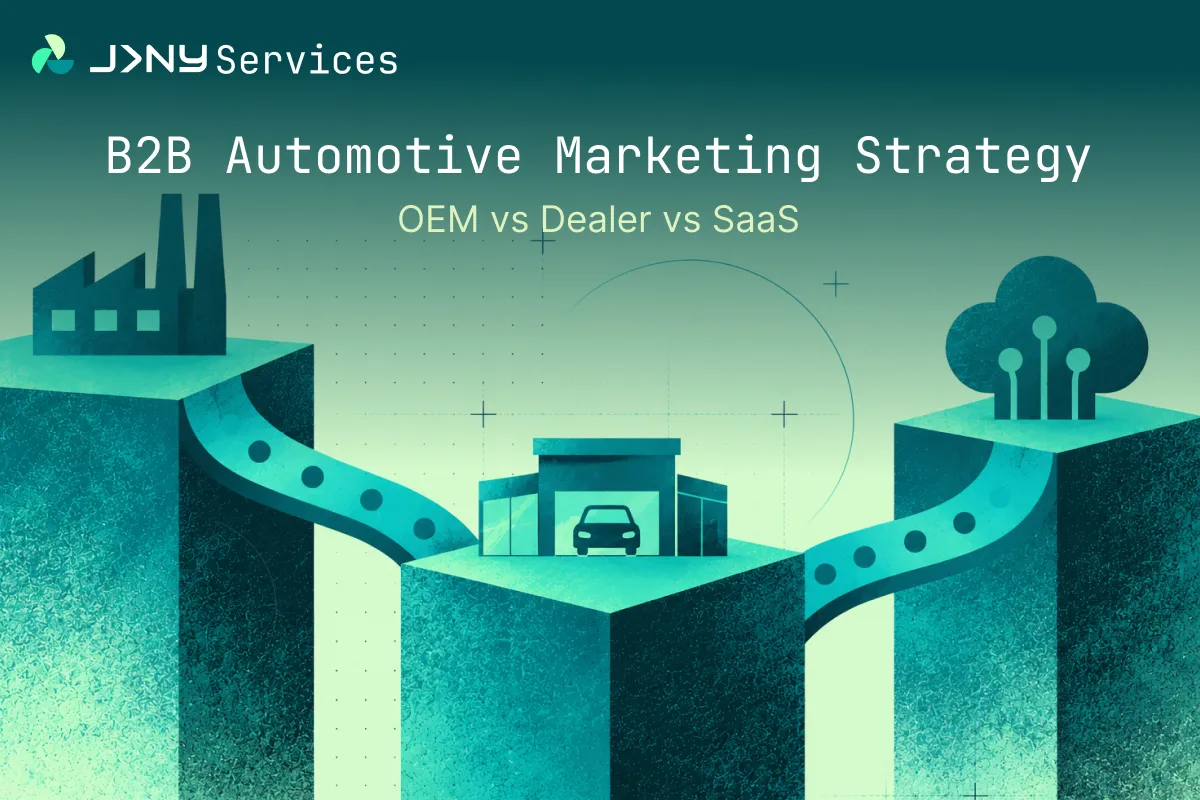
Ask an OEM brand director, a dealer principal, and a mobility SaaS founder to describe their marketing strategy, and you get three different answers, because they are not running the same business. A generic automotive marketing strategy B2B teams borrow from one segment and force onto another rarely survives contact with reality. OEMs are managing brand equity across a national dealer network. Dealers are chasing this week's showroom traffic on razor-thin margins.
Automotive SaaS and mobility-tech companies are selling five and six-figure contracts to buying committees who have never heard of them. Each of these businesses has a different budget, a different sales cycle, and a different definition of a qualified lead. Understanding which one you are actually running, and building your channel mix, messaging, and funnel around it, is what separates a marketing budget that compounds from one that just gets spent.
Key Takeaways
- OEM, dealer, and SaaS automotive businesses need fundamentally different channel strategies, not variations on the same campaign.
- Dealers optimise for speed and local intent; OEMs optimise for brand equity and network-wide consistency; SaaS companies optimise for trust with a multi-person buying committee.
- Funnel design has to match sales cycle length. A dealer funnel measured in days cannot be copied onto a SaaS funnel measured in months.
- Growth stage matters as much as segment. What works at launch actively works against you at scale.
Why a Single Automotive Marketing Strategy B2B Playbook Doesn't Work for Everyone
The phrase "automotive marketing" gets used as if it describes one discipline. It does not. An OEM spending against a national campaign, a dealer running local paid search, and a SaaS vendor building a content engine for fleet software buyers are solving entirely different problems, even though they all sell into the same industry.
The global auto advertising market was valued at an estimated $38.43 billion in 2025, projected to climb past $41.5 billion in 2026, but that figure blends OEM brand spend with dealer-level acquisition budgets that behave nothing alike. Treating them as a one line item is the first mistake most B2B automotive marketing strategy workers make, and it is why campaigns built for one segment consistently underperform when ported to another.
OEM Marketing: Brand Equity, Co-op, and the Long Game
OEM marketing operates on a multi-year horizon. The job is to build brand equity and trust at a national or regional level, then push a share of that budget down through the dealer network via co-op advertising, which typically reimburses 50 to 100% of qualifying local spend. This is a control problem as much as a creative one: OEMs need thousands of independently owned dealers to represent the brand consistently while still responding to local market conditions.
Incentive design sits alongside brand campaigns as a core OEM lever. Cox Automotive data shows consumer-facing incentive spend reached 7.3% of average transaction price by mid-2025, and that figure only captures the visible layer. Behind it sits training certification bonuses, CSI performance rewards, and aftersales incentives that shape how dealers actually behave, not just how much they spend.
Dealer Marketing: Local Intent, Speed, and Margin Pressure
Dealers are running a completely different playbook. The average dealership now spends close to $740 in advertising per new vehicle sold, with roughly 60% of that budget concentrated in paid search, third-party marketplaces, and SEO. The sales cycle is measured in days, not months, and the job of dealer marketing is converting local, high-intent traffic before a competitor three miles away does it first.
This creates a very different set of priorities to OEM marketing. Dealers care less about long-term brand narrative and more about cost per lead, mobile conversion rate, and how quickly a lead response turns into a showroom visit. A B2B automotive marketing approach aimed at dealers needs to speak directly to that urgency, not to abstract brand positioning.
SaaS and Mobility-Tech Marketing: Selling to Committees, Not Customers
Automotive SaaS is where most generic playbooks fail hardest, and it is a topic we have covered in detail before. You are not selling to one buyer. You are selling to a committee that includes operations, finance, and IT security, each with a different objection, over a sales cycle that can run six to eighteen months.
Channel Strategy by Segment
Channel selection has to follow sales cycle length and deal size. SaaS companies with contracts above roughly $50,000 in annual value typically need a sales-led motion built on demos, case studies, and direct outreach, where content and SEO support the pipeline rather than closing it alone. Dealers, by contrast, live and die on paid search and marketplace visibility. OEMs invest in brand media and co-op infrastructure that dealers can activate locally. Copying a dealer's paid search strategy onto a SaaS GTM automotive motion, or vice versa, wastes budget on channels the buyer isn't using at that stage of their journey.
Messaging Clarity: What Each Buyer Actually Wants to Hear
A dealer's customer wants speed and a good deal. An OEM's dealer network wants consistency and margin protection. A SaaS buying committee wants proof that your platform will not become the "vaporware" that fails in the field, a concern we explored when breaking down why automotive buyers distrust marketing content in the first place. Messaging that works for one audience will actively undermine credibility with another.
Funnel Design: Why One Funnel Doesn't Fit All Three
Funnel design is not a template you reuse across segments. A dealer funnel needs to compress the modern automotive buyer's research-heavy journey into a fast local conversion, often within a single visit. An OEM funnel is closer to a brand-building loop that feeds the dealer network rather than converting directly. A SaaS funnel has to nurture a buying committee over many months, answering different departmental questions at each stage, from initial discovery through technical evaluation to procurement sign-off.
The practical failure mode is building a short, high-pressure dealer-style funnel for a SaaS product with a twelve-month sales cycle, or building a slow, education-heavy funnel for a dealer audience that wants an answer in minutes. Matching funnel length and content depth to the actual decision timeline of your segment is a foundational part of any credible automotive marketing strategy B2B teams can execute against consistently.
Matching Strategy to Growth Stage: Launch, Grow, Scale
Segment is only half the equation. Growth stage changes what "working" looks like within each segment. A SaaS company at launch needs to establish a minimum viable presence, deep technical content and early case studies that prove the product works outside a lab environment. At the grow stage, the priority shifts to targeted distribution and account-based outreach that keeps the brand visible through a long, quiet sales cycle. At scale, marketing automation and CRM integration take over so that volume increases without a proportional increase in headcount.
Dealers experience the same shift on a shorter timeline. A newly opened rooftop needs aggressive local visibility to establish presence. An established dealership group shifts budget toward retention and service marketing, a category that industry benchmarking shows generates roughly 49% of dealership gross profit while receiving under 15% of marketing spend at most stores, a structural misallocation worth correcting before adding more acquisition budget.
Building a B2B Automotive Marketing Strategy That Scales With You
At JRNY Services, we work across all three of these segments, which is exactly why we resist templated campaigns. A brand-equity play built for an OEM dealer network does not translate to a SaaS buying committee, and a fast local funnel built for a dealer rooftop will not survive a twelve-month enterprise sales cycle. Our marketing services team builds channel strategy, messaging, and funnel architecture specific to the segment and growth stage you are actually in, backed by proof points from mobility, SaaS, and automotive clients in our case study library.
If your current marketing strategy was designed for a different kind of automotive business than the one you are running today, that mismatch is worth fixing before you spend another quarter's budget on it.
Frequently Asked Questions
1. What's the core difference between OEM and dealer automotive marketing strategies?
OEM marketing builds long-term brand equity across an entire dealer network and funds local activity through co-op programmes, while dealer marketing focuses on short-cycle, high-intent local conversion. OEMs think in years; dealers think in days.
2. How does B2B SaaS marketing differ from OEM or dealer marketing in automotive?
SaaS marketing sells to a multi-person buying committee over a sales cycle that can run six to eighteen months, requiring sustained trust-building content rather than the fast conversion tactics that work for dealer traffic or the brand-level campaigns OEMs run.
3. Which channels work best for early-stage automotive SaaS companies?
Early-stage automotive SaaS companies typically need a mix of technical content, case studies, and direct outreach aimed at named accounts, since paid search alone rarely reaches the operations, finance, and IT stakeholders involved in enterprise buying decisions.
4. Should automotive marketing funnels look the same across OEM, dealer, and SaaS businesses?
No. Funnel length and content depth need to match the buyer's actual decision timeline. A dealer funnel compresses to a single visit, an OEM funnel supports the dealer network rather than converting directly, and a SaaS funnel has to nurture a committee across many months.
5. When should a growing automotive business change its marketing strategy?
Strategy should shift with the growth stage, not stay fixed. What builds initial credibility at launch, such as deep technical content or aggressive local visibility, is not the same as what sustains growth once demand is established and the priority becomes automation, retention, and efficient scaling.