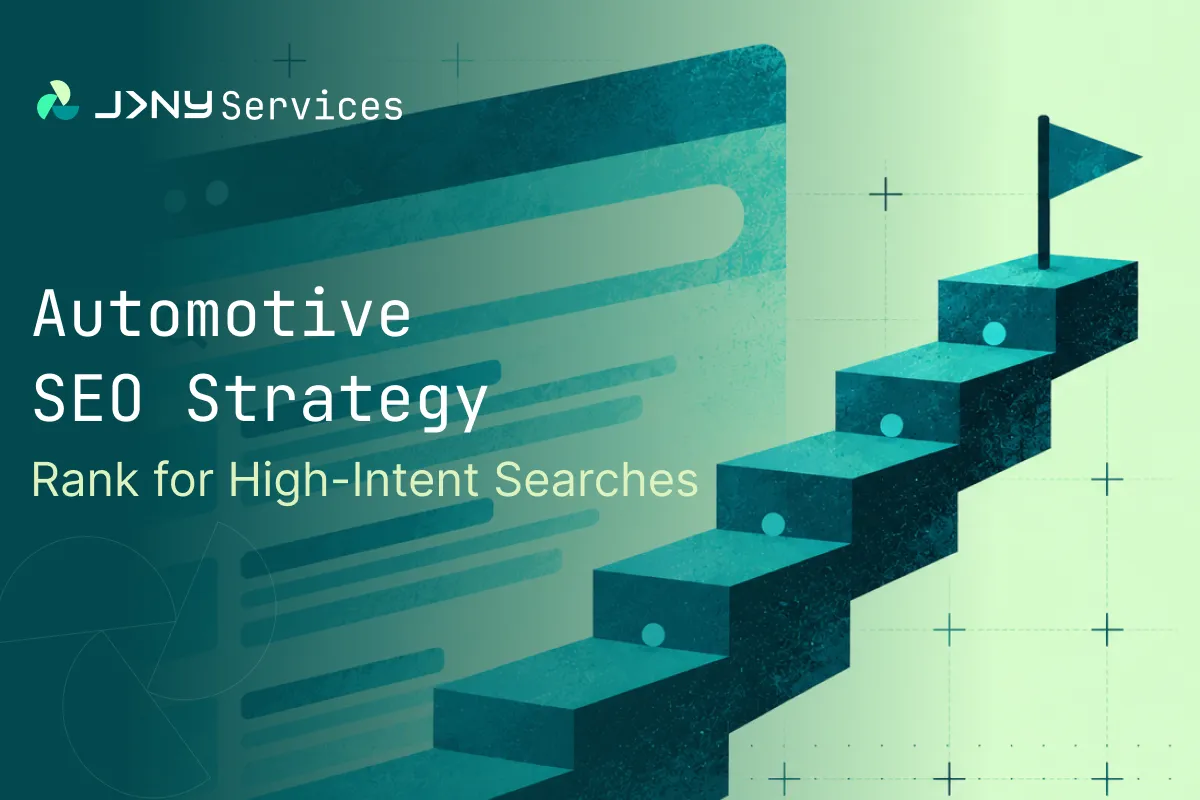
Most automotive SEO strategy work still optimises for search volume instead of buying intent, and that single mistake explains why so many dealerships and automotive SaaS companies see rising traffic with flat pipeline. Ranking for a broad term like "car maintenance tips" might pull in tens of thousands of visitors a month, but almost none of them are close to a purchase decision.
An automotive SEO strategy built around what people are actually trying to decide, not just what they're typing into Google, looks completely different: fewer keywords, more specific pages, and content mapped to exactly where a buyer sits in their research. The payoff compounds, because organic search is one of the only automotive marketing channels where cost per lead falls the longer you invest in it, rather than rising with competition the way paid channels do.
Key Takeaways
- Ranking for high search volume without commercial intent produces traffic that rarely converts into pipeline.
- Search intent, not keyword volume, should determine which pages get built and how they're structured.
- Content clusters built around topical authority compound over time, unlike paid channels.
- Decision-stage content deserves disproportionate investment relative to its search volume, because it converts at a completely different rate.
The Automotive SEO Myths Costing You Qualified Traffic
The most persistent automotive SEO myth is that more content always helps. Publishing generic, broad-topic articles chasing high-volume keywords like "best cars 2026" might move a traffic dashboard, but it rarely moves pipeline, because those searchers are nowhere near a purchase decision and have little reason to convert on a dealership or SaaS platform's website.
A second myth is that automotive SEO is primarily a technical exercise: page speed, schema markup, crawl budget, and little else. Technical SEO matters, but it's a floor, not a strategy. A perfectly optimised page built around the wrong keyword intent still won't generate revenue. The brands winning in automotive SEO right now treat it as a content and intent problem first, and a technical problem second.
Search Intent: The Foundation Most Automotive SEO Skips
Search intent sorts every keyword into a category, informational, commercial, or transactional, and each category needs a genuinely different type of page. An informational query like "how does car subscription work" deserves an educational article. A commercial query like "best car subscription platforms for dealers" deserves a comparison page. A transactional query like a direct product demo search deserves a conversion-focused landing page with minimal distraction.
The mistake most automotive sites make is building one type of page and pointing every keyword at it. A single service page trying to rank for an educational term, a comparison term, and a pricing term simultaneously usually ranks for none of them well, because Google's own intent-matching systems can tell the page doesn't actually match what the searcher is trying to accomplish. Mapping search intent to buyer stage is the same discipline behind how automotive buyers actually research and compare before converting; an automotive SEO strategy just needs to mirror that journey in how content gets structured.
High-Intent Queries: Where the Actual Pipeline Lives
High-intent queries carry commercial modifiers, pricing, demo, near me, comparison, best-for, and they convert at a completely different rate than broad informational searches. Research-stage keywords convert at two to three times lower rates than commercial and transactional terms, which means a content strategy weighted too heavily toward top-of-funnel education, without a clear path to decision-stage content, generates visibility without generating revenue.
This is precisely the trap that campaigns built around demand capture instead of genuine demand creation fall into, chasing volume metrics that look impressive in a monthly report while the sales team keeps asking why lead quality hasn't improved. Prioritising a smaller number of high-intent pages, built specifically around the language buyers use when they're ready to compare or buy, consistently outperforms a larger volume of generic content.
Content Clusters: Building Topical Authority That Compounds
Content clusters, a pillar page supported by a set of interlinked articles covering every angle of a topic, are how automotive brands build the topical authority Google now rewards over isolated blog posts. Sites that build proper cluster architecture see organic traffic increase by roughly 40% through topical authority alone, because Google's helpful content systems evaluate depth and breadth of coverage across a subject, not just the strength of any single page.
For an automotive brand, this might mean a pillar page on vehicle subscription models supported by cluster articles on pricing, insurance, mileage limits, and comparisons against leasing, each linking back to the pillar and to each other. The compounding effect is the real prize: dealer content built this way delivers leads at 75 to 85% lower cost once it matures, compared to paid acquisition that never gets cheaper no matter how long a campaign runs.
Decision-Stage SEO: Ranking for the Moment Buyers Are Ready to Act
Decision-stage SEO deserves more attention than its search volume alone would suggest. These are lower-volume, highly specific queries, comparison pages, pricing pages, "vs" pages, and location-based commercial searches, and they represent buyers who have already done their research and are choosing between a short list of options. Yet SEO investment still trails paid search in most dealer budget allocations, even though it delivers the highest-quality traffic of any organic channel at the exact point a buyer is ready to act.
Winning decision-stage SEO means building the exact pages a buyer compares before they choose: transparent pricing pages, direct competitor comparisons, and location or use-case-specific landing pages that answer the narrow question a buyer actually has, rather than a generic service page hoping to catch every possible search.
Measuring Results: What Actually Proves an Automotive SEO Strategy Is Working
Traffic growth alone proves very little about whether an automotive SEO strategy is working. The metrics that matter are ranking position for commercial and transactional keywords specifically, conversion rate by landing page, and cost per qualified lead tracked over time against paid channels. A programme that is actually working shows a widening gap between organic and paid cost per lead every quarter, not a flat traffic chart that looks the same regardless of what content gets published.
This is also where most automotive SEO reporting falls short: measuring impressions and average position across an entire domain hides the fact that most of that visibility often sits on informational content that was never meant to convert. Segmenting performance by search intent category, not just by page, is the only reliable way to see whether decision-stage content is actually carrying its weight.
How JRNY Builds Automotive SEO Strategy
At JRNY Services, we build automotive SEO strategy around intent mapping first and content production second, because publishing volume without a clear intent structure just adds noise to a site that already has enough of it. Our marketing services team builds pillar and cluster architecture specifically for the automotive and mobility sector, weighted toward the decision-stage content that turns organic visibility into pipeline. As AI-powered search continues to reshape how automotive buyers discover brands, a shift we've covered in detail in our look at what AI search means for automotive brands, the foundational discipline of intent-mapped content clusters becomes more valuable, not less, since AI systems draw on the same topical authority signals that traditional search already rewards.
If your organic traffic has grown but your pipeline hasn't followed, the gap is almost always intent, not volume.
Frequently Asked Questions
1. What's the biggest mistake in automotive SEO strategy?
Optimising for search volume instead of buying intent. High-traffic, low-intent keywords fill an analytics dashboard without moving pipeline, while smaller volumes of high-intent, decision-stage traffic quietly drive most of the actual leads.
2. How does search intent affect automotive SEO performance?
Search intent determines what type of page should target a keyword. Informational, commercial, and transactional queries each need a different page structure, and mismatching intent to page type is one of the most common reasons a page fails to rank despite solid content.
3. Why do content clusters outperform standalone blog posts for automotive brands?
Google's ranking systems now reward demonstrated topical authority across a subject, not just individual page quality. A well-built cluster of interlinked articles covering every angle of a topic consistently outranks a single standalone post on the same subject.
4. Should automotive SEO prioritise search volume or commercial intent?
Commercial and transactional intent, even at lower search volume, because those queries convert at a substantially higher rate. A smaller set of high-intent pages typically generates a more qualified pipeline than a much larger volume of generic informational content.
5. How is automotive SEO strategy different from optimising for AI search and AI Overviews?
Foundational SEO strategy, intent mapping, content clusters, and topical authority, forms the base that AI search systems draw from when generating answers. The disciplines aren't separate: strong topical authority built through traditional SEO is what earns citations in AI-generated results too.