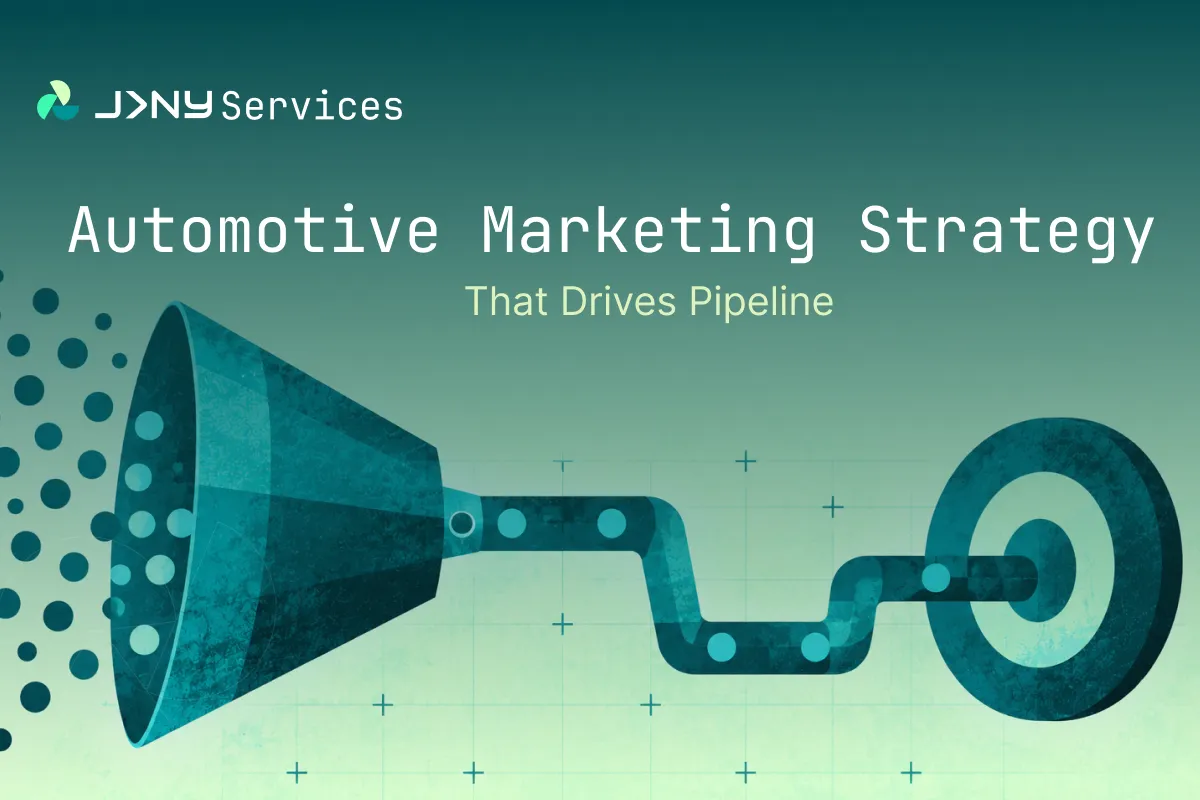
A strong automotive marketing strategy in 2026 is no longer about the volume of your activity. It is about the structural clarity of your systems. Most OEMs, mobility startups, and automotive SaaS providers are still measuring success by surface-level metrics: clicks, impressions, raw lead volume. Yet their sales teams remain starved for genuine, high-intent opportunities.
The evidence is striking. According to Bain and Company's research published in the Harvard Business Review, 80-90% of B2B buyers already have a shortlist of vendors in mind before they begin their formal research, and 90% ultimately choose from that original list. Your pipeline is either being built during the invisible research phase, or it is not being built at all.
Why Most Automotive Marketing Strategies Fail
The primary reason most strategies fail is what we call the Activity Trap. Marketing teams are incentivised to produce high volumes of leads, regardless of their readiness to buy or fit within the Ideal Customer Profile. This creates friction where sales teams spend more time qualifying poor leads than closing deals.
In automotive and mobility tech, products are inherently complex. When a website or content strategy fails to signal credibility or simplify that complexity, buyers move on to a competitor who makes the decision feel safer. Many businesses compound this by juggling multiple disconnected agencies, resulting in a brand voice that feels disjointed and a growth engine with no single owner of outcomes.
There is also a failure to account for the Silent Shortlist. If your strategy is purely transactional and focused on capturing demand at the last moment, you have already lost to the competitor who spent months building that demand through education and trust.
Activity vs Outcomes: Shifting the Focus
To drive real pipeline in 2026, marketing must shift from activity to outcomes. In the legacy model, success was a viral social post or a high number of whitepaper downloads. In the outcome-led model, success is defined by the velocity and quality of the sales pipeline.
This requires a realignment of metrics. Instead of Cost Per Lead, forward-thinking automotive brands are measuring Cost Per Qualified Opportunity. This shift forces marketing to act as a true revenue partner rather than a cost centre, where every piece of content serves a defined purpose: to educate, to build credibility, or to remove a specific barrier to conversion.
This focus on long-term trust is particularly vital for businesses dealing with long, relationship-led sales cycles, which is the norm across automotive SaaS, fleet technology, and subscription mobility.
The Role of Clarity in High-Consideration Buying
In a high-consideration market where purchase decisions are trust-led and financially significant, clarity is your greatest competitive advantage. Many automotive tech and mobility platforms struggle to explain their offerings simply, leading to persona confusion and lost opportunities.
The fix is moving from talking about features to talking about outcomes. A buyer does not want to know how your fleet management software works in technical detail. They want to know how it reduces their operational downtime and improves their bottom line.
Clarity also extends to your digital presence. A website must act as a 24/7 sales representative that signals instant credibility. If a prospect cannot understand your value proposition within the first ten seconds of landing on your page, they will not stay for the eleventh. This is why strong automotive digital marketing starts with digital foundations done properly: websites, tracking, structure, and conversion basics.
Aligning Your Automotive Marketing Strategy with 2026 Buyer Behaviour
The modern automotive buyer is more informed and more sceptical than ever. According to 6sense's Buyer Experience research, buyers are around 60-70% of the way through their purchasing process before engaging with sellers, and the pre-contact favourite wins the deal roughly 80% of the time. Your digital content is, in effect, your first sales meeting.
This journey is no longer a linear funnel. It is a multi-touch ecosystem. Buyers move between vendor sites, third-party marketplaces, LinkedIn thought leadership, and AI-driven search results. To stay relevant, your automotive marketing strategy must be present across all of it. This means optimising not just for traditional search, but for Large Language Models and AI recommendation layers, which is where a growing proportion of B2B buyers now begin their research.
At JRNY Services, we grow demand by building content strategies that compound over time, focused on three pillars: trust-first SEO that captures high-intent keywords; LLM optimisation that ensures your brand surfaces when AI tools answer category questions; and sales enablement content that helps your team close deals rather than just open doors.
Building Systems: Scale Without Expensive Headcount
For many scaling businesses in the UK, Europe, and the US, growth often becomes a cost problem before it becomes a demand problem. Traditional scaling means hiring more marketing managers, more SDRs, and more analysts, which balloons fixed costs and increases operational strain.
The 2026 solution is to build systems and automation into the fabric of the business. By combining AI-led workflows with a hybrid delivery model, it is possible to maintain UK-level strategic oversight and quality while remaining significantly more cost-effective than comparable local agencies.
McKinsey's B2B research consistently shows that companies combining personalised outreach with omnichannel execution are 1.7 times more likely to grow market share than those that are not. The companies investing in AI as infrastructure today are the ones that will maintain their margins as they scale.
Creating a Long-Term Pipeline Engine
A sustainable pipeline is not built on quick-win marketing or short-term tactics. It is built through consistent presence that builds authority month after month.
This requires a full-journey capability. You cannot fix your pipeline by only looking at your ads. You must examine your positioning, your website conversion, and your operational follow-up. The goal is a growth engine that is visible, credible, and ready to scale, whether you are navigating the long sales cycles of OEM software or launching a new subscription mobility model.
Your Automotive Marketing Strategy for 2026
The reality of the 2026 landscape is that buyers have all the power. They do not want to be sold to. They want to be educated and reassured. An effective automotive marketing strategy today is one that respects the buyer's journey, simplifies the complex, and uses smart operations to scale efficiently.
Stop juggling disconnected partners and start building a scalable growth engine. Contact JRNY Services to audit your current pipeline strategy and identify where the highest-impact changes are.
FAQs
1. What drives pipeline in automotive marketing for SaaS companies?
The businesses that consistently win qualified pipeline are the ones that make a complex product feel simple and safe to buy. B2B buyers in automotive do most of their research before they ever speak to anyone, so if your content is full of technical features rather than real-world outcomes, you are losing people before a conversation even starts. Focus on what the product actually does for the buyer: less downtime, better margins, fewer operational headaches. That is what moves someone from passive reader to active prospect.
2. How do you build an automotive pipeline without high ad spend?
By earning your place on the shortlist before buyers start their formal evaluation. Most B2B buyers already have two or three vendors in mind before they begin comparing options in earnest. If your brand is not one of them, no amount of ad spend at the bottom of the funnel will save you. Education-led content and trust-first SEO get you into that consideration set early, through genuine usefulness rather than paid interruption. The pipeline follows from that, and it tends to be better quality too.
3. What is the best automotive marketing strategy B2B for 2026?
One that treats growth and operations as the same problem. A lot of automotive businesses have the demand side figured out well enough, but fall short on the systems that make that demand convertible at scale. The strongest strategies combine content that compounds over time with AI and automation that removes the need to keep hiring to keep up. McKinsey's research shows that companies combining personalised outreach with omnichannel execution are 1.7 times more likely to grow market share, and the pattern holds in automotive as much as anywhere else. Visibility, credibility, and efficient operations are not separate priorities. They are the same one.