Here is a scenario that plays out in automotive marketing teams more often than anyone likes to admit. The monthly report looks healthy: MQLs are up, the cost per lead is within budget, and the campaign dashboard shows plenty of activity. But the pipeline tells a different story. Sales is spending half its time disqualifying contacts who were never serious buyers. The deals that do close are taking longer. And nobody can quite explain where the good opportunities are actually coming from.
This is what happens when you optimise for lead generation without first building demand. And in the automotive industry, where buying decisions are high-consideration, trust-led, and increasingly driven by months of independent research - the gap between those two things matters enormously.
Automotive demand generation strategy and lead generation are not the same thing, and conflating them is one of the most expensive mistakes a growing automotive business can make. This article explains the difference, why it matters specifically in automotive and mobility markets, and what a strategy that actually builds qualified pipeline looks like in practice.
The Difference Between Demand Generation and Lead Generation in Automotive B2B Marketing
The simplest way to understand the distinction is this: demand generation creates the conditions for buying, and lead generation captures buyers when those conditions are met.
Lead generation is transactional. A prospect fills out a form, downloads a whitepaper, or responds to an ad. A contact record is created, a sales sequence is triggered, and the machinery of follow-up begins. Done well, it is efficient. Done without demand generation feeding it, research consistently shows that around 79% of leads never convert into sales due to poor qualification and low intent. The leads look real. They just never had sufficient reason to buy.
Demand generation works upstream. It is the blog post that a Head of Fleet reads six months before they start evaluating telematics platforms. It is the LinkedIn article that a Commercial Director bookmarks because it finally explains something they had been confused about. It is the thought leadership that establishes your brand as the obvious reference point in its category — so that when a buyer is finally ready to raise their hand, your name is already on the shortlist.
Cognism's shift from lead generation to demand generation is one of the most instructive documented case studies in B2B marketing. Their close rate from gated content leads was around 0.2%. After moving to ungated educational content and brand-led demand generation, they quadrupled their inbound pipeline with significantly higher win rates. The volume of leads went down. The quality, and the revenue, went up substantially.
Why Lead Generation Alone Fails in Automotive B2B Marketing
Automotive and mobility markets are structurally poor environments for a pure lead generation approach. Several specific characteristics make this especially true.
- Buying decisions are high-consideration and trust-led. Whether the buyer is a consumer weighing up a car subscription or a procurement team evaluating fleet management software, the decision involves real financial commitment and perceived risk. Buyers in this position do not respond well to being "captured" before they are ready. They need to be educated, reassured, and given time to form a view. Push them into a sales process before that foundation is built and the result is a pipeline full of contacts who are not close to buying.
- The buying journey is long and largely invisible. According to 6sense's 2024 Buyer Experience Report, over 70% of the B2B buying process happens before a buyer ever contacts a vendor. For automotive SaaS and mobility businesses with sales cycles measured in months, this means the majority of the journey, during which buyers form preferences and assemble shortlists, is taking place in channels that lead generation tactics cannot reach. A gated whitepaper captures someone who has already done the hard work of self-education. It misses everyone still in the research phase, which is where preferences are actually formed.
- Paid advertising struggles in niche automotive markets. The audiences are smaller, the keywords are more expensive, and the buyers are more sceptical. A business bidding on "fleet management software UK" is competing for a small, high-value audience that is actively comparing vendors, and that audience will not convert from an ad until they already trust the brand behind it. Running aggressive lead generation ads before that trust exists produces high cost per lead and low conversion rates. The economics only work when demand generation has already done its job.
- Lead quality in automotive B2B is a persistent, measurable problem. 53% of B2B marketers report that at least 10% of their leads are disqualified by sales due to poor quality. In automotive, where sales cycles are long and sales team capacity is finite, a pipeline filled with unqualified contacts is not just inefficient, it is actively damaging to the business.
- The automotive sector has its own compounding complexity. Fleet procurement often involves multiple stakeholders, from fleet managers, finance directors, sustainability leads, to procurement teams, each with different information needs and different points of entry into the research process. EV fleet transitions, for example, involve evaluating charging infrastructure, whole-life costs, and policy compliance alongside vehicle selection. No single lead capture moment reflects that complexity. Demand generation that educates across each of those dimensions is what earns a place on the shortlist.
What Demand Generation Looks Like in Automotive
Effective automotive demand generation is not a campaign. It is a system. It is the sustained work of building visibility, credibility, and buyer education across the channels where automotive buyers are actively forming views - long before they are ready to become a lead.
In practice, this means:
- Educational content that earns organic visibility. Long-form guides, explainer articles, and thought leadership that answers the specific questions automotive buyers are searching for at the research stage. Not promotional, not gated. Genuinely useful content that positions your brand as the most credible voice in its category, whether that is fleet decarbonisation strategy, total cost of ownership modelling, or mobility-as-a-service procurement.
- Consistent thought leadership on LinkedIn. Senior automotive buyers are active on LinkedIn. A consistent presence offering genuine insight - on fleet trends, mobility business models, EV adoption challenges, or procurement complexity - builds familiarity and authority with exactly the people who will be on buying committees six months from now.
- SEO optimised for automotive buyer intent, not just volume. Long-tail, niche keywords that reflect the actual questions automotive buyers ask during the research phase capture qualified traffic that generic high-volume keywords miss. A fleet manager searching "how to reduce fleet downtime" or "EV fleet total cost of ownership" is a better prospect than someone searching "fleet software", even if the second query has ten times the volume.
- LLM and AI search visibility. With a growing proportion of automotive buyers beginning their research with AI tools, appearing in AI-generated recommendations for relevant queries is rapidly becoming part of demand generation. Structured, authoritative content that clearly answers category questions is the foundation of LLM visibility.
- Ungated evidence and proof. Case studies, outcome data, and client results shared openly, not locked behind forms, give buyers the evidence they need to include your brand on a shortlist without requiring them to identify themselves first. The goal at the demand stage is not data capture. It is credibility building.
When Lead Generation Becomes the Right Tool
Lead generation is not the enemy of a good pipeline. It is the wrong tool when used too early and without the demand foundation to support it. Used at the right moment, when buyers are already educated, already familiar with your brand, and actively looking for a solution, lead generation is highly efficient.
The practical implication is sequencing. Build demand first, then use lead generation to capture the intent you have created. 68% of B2B marketers credit demand generation with delivering higher quality leads than traditional acquisition methods, because buyers who have been educated through demand generation arrive at conversion points with better context, stronger intent, and a pre-existing sense of trust in the brand.
For automotive businesses in growth mode, this means investing in demand generation even when it does not produce immediate, attributable leads. The pipeline impact is real, but it compounds over time. Content published today influences a buying decision six months from now. Thought leadership read by a Commercial Director today puts your brand on a shortlist they build next quarter.
Measuring What Actually Matters
One reason automotive businesses default to lead generation is that it is easier to measure. Form fills, cost per lead, MQL volume - these are clean, reportable numbers. Demand generation is harder to attribute, especially in the short term.
The answer is not to abandon measurement, it is to measure the right things. A campaign that generates 200 MQLs but closes two deals is performing worse than one that generates 40 MQLs and closes twelve. The metrics that reveal genuine commercial momentum are: pipeline quality over lead volume; sales cycle length over lead count; win rate by lead source; and revenue generated per marketing channel over a 12-month window.
At JRNY Services, we build demand generation systems for automotive and mobility businesses that are designed to compound over time, not just produce activity. We connect SEO, content, thought leadership, and LLM optimisation into a single growth engine, and we measure it against the metrics that actually matter: pipeline quality, sales cycle velocity, and revenue per marketing channel.
Build the Demand, Then Capture It
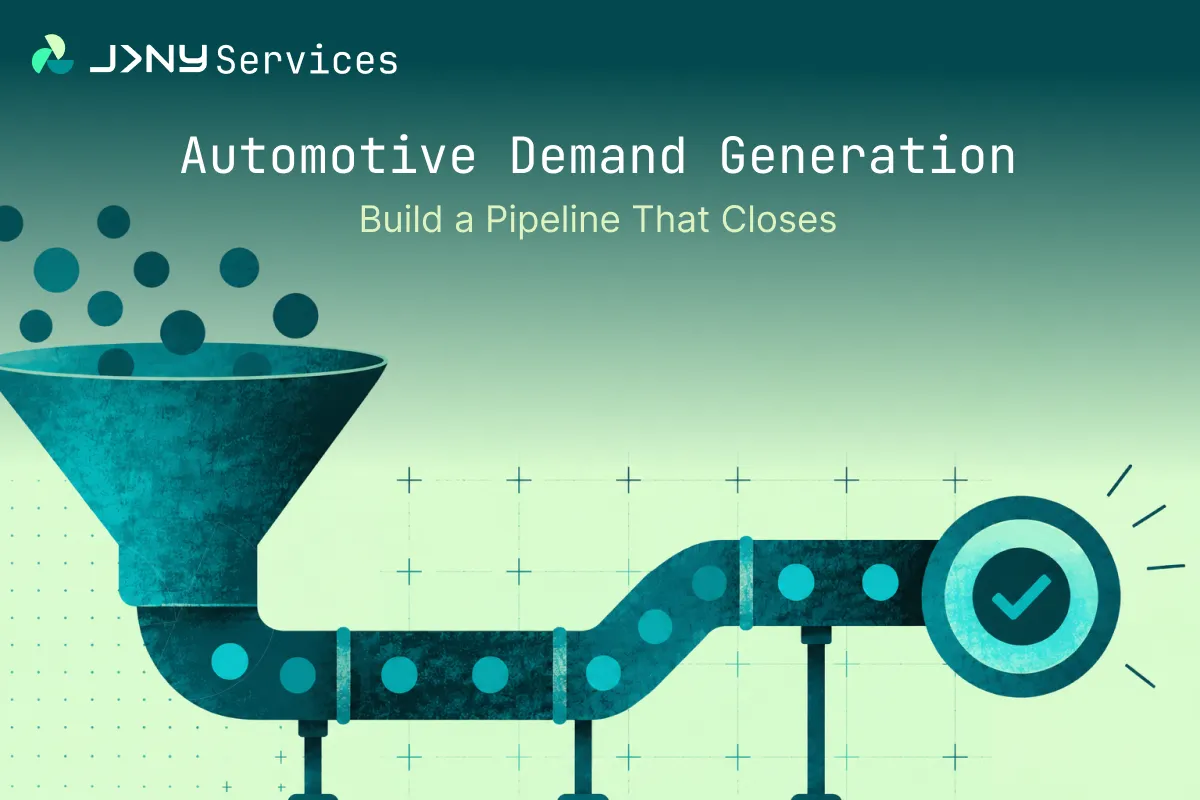
The question for most automotive businesses is not whether to do demand generation or lead generation. It is whether they are doing both in the right order. Lead generation without demand generation produces low-quality pipeline. Demand generation without lead generation leaves qualified intent uncaptured. The combination, sequenced correctly, is what builds a pipeline that closes.
In a market where buying decisions are trust-led, research-heavy, and increasingly made before a buyer ever identifies themselves, the automotive businesses that invest in building demand today are the ones whose pipelines will be full of genuinely qualified opportunities tomorrow.
If your current strategy is generating leads but not revenue, the problem is almost certainly upstream. Contact JRNY Services to audit your current pipeline strategy and identify where demand generation investment would have the highest impact.
FAQs
1. What is the difference between demand generation and lead generation in automotive?
Demand generation is everything you do to make buyers aware of you and favourably disposed towards your brand before they are anywhere near a purchase decision. Lead generation is what happens when a buyer is finally ready to act and you capture that intent.
The distinction matters in automotive because the trust bar is high and the sales cycle is long. A fleet manager evaluating telematics software won't convert from a cold ad. They need to have encountered your brand, found it credible, and formed a view, often over several months. Lead generation without that foundation just fills the pipeline with people who were never close to buying.
2. How do I generate qualified automotive leads?
Stop trying to generate them directly, and start creating the conditions that make them arrive naturally. Buyers who convert well are the ones who already understand their problem, have done their research, and have your brand on their shortlist before they ever raise their hand. That doesn't come from a well-targeted ad or a gated download. It comes from educational content and brand presence that has been quietly doing its job. Build that foundation first. The qualified leads follow from it, and they close faster because the selling has largely already happened.
3. What does an automotive demand generation strategy look like in practice?
Less like a campaign, more like a publishing and visibility operation that runs consistently in the background. In practice: educational content that answers the questions your buyers are actually searching for, covering fleet decarbonisation, total cost of ownership, and EV procurement, without gating it. A consistent LinkedIn presence that reaches senior decision-makers before they are in-market. Case studies shared openly so buyers can self-qualify without talking to sales. And content structured to surface in AI-assisted research, where a growing number of B2B buyers now begin. The goal at this stage is not conversion. It is to be the most credible option when the moment to convert finally arrives.