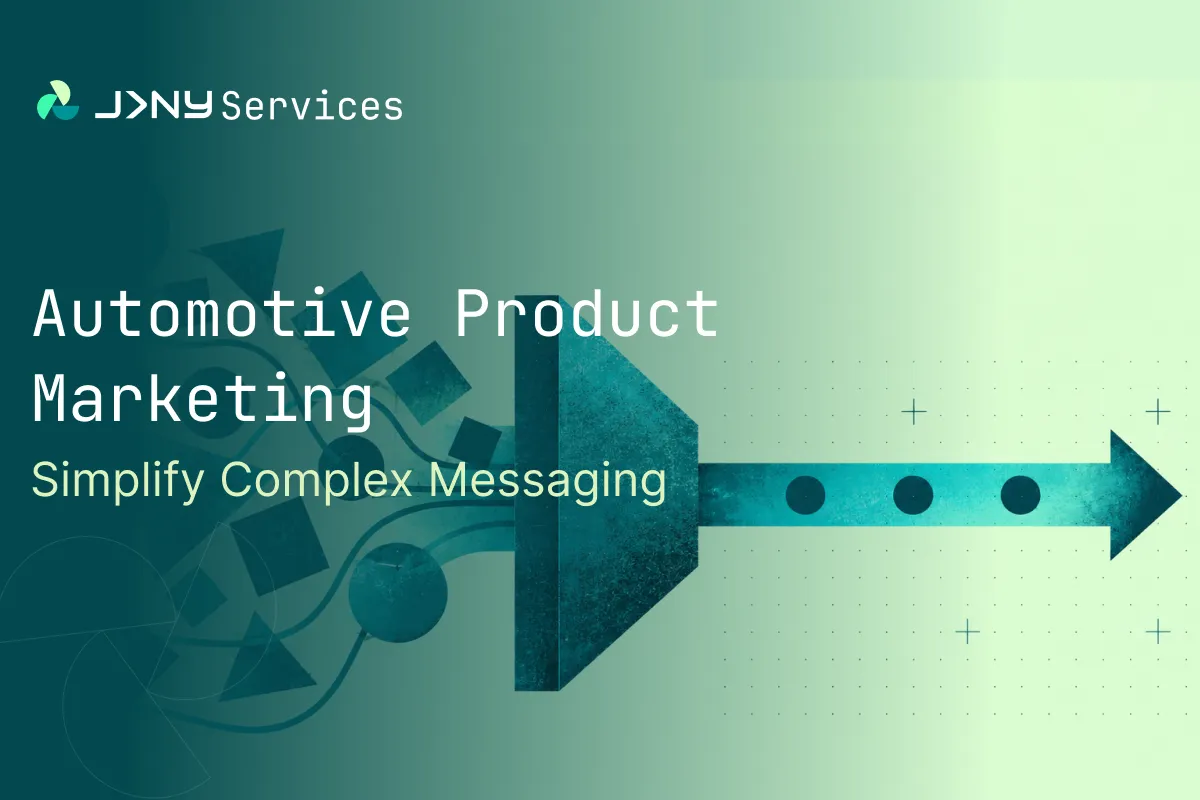
Automotive product marketing has a strange problem: the more sophisticated the product, the worse the marketing tends to get. A predictive maintenance platform, a fleet telematics system, or a subscription management engine solves a genuinely hard operational problem, and that complexity has a habit of leaking straight into the homepage copy. Engineers explain the architecture. Product marketers list every integration. The result reads like a specification sheet, not a reason to buy.
Automotive product marketing that leads with technical depth instead of a clear outcome consistently underperforms simpler positioning, even when the underlying product is better. Getting this right means resisting the instinct to explain everything and instead explaining the one thing that matters to the person reading.
Key Takeaways
- Complex automotive and mobility products underperform in marketing not because the technology is weak, but because messaging explains mechanisms instead of outcomes.
- Feature-first copy reliably converts worse than outcome-first, problem-solution messaging.
- Trying to speak to every buyer persona on one page usually reaches none of them clearly.
- Structuring copy as problem, then outcome, then proof, then features improves clarity and conversion together.
The Complexity Problem in Automotive Product Marketing
Complex products create a specific kind of marketing failure: buyers who genuinely need the solution can't tell, from the website, whether it solves their problem. This isn't a hypothetical risk. Recent buyer research shows that 77% of B2B buyers describe their last purchase as complex or difficult, with a significant share of purchases stalling somewhere in the buying process entirely. Automotive SaaS and mobility-tech products sit squarely in this category. Fleet software, telematics, subscription platforms, and dealership management systems all involve genuine technical depth that most buyers on the other side of the screen are not equipped to evaluate on specification alone.
The instinct, understandably, is to prove competence by demonstrating depth. Founders and product teams who spent years building something technically impressive want the marketing to reflect that effort. But a buying committee facing half a dozen or more stakeholders and dozens of vendor touchpoints doesn't reward depth. It rewards clarity. This is the same translation layer problem we've seen derail automotive SaaS marketing more broadly: real technical capability that never gets converted into a business outcome a buyer can act on.
Feature vs Outcome: The Gap That Kills Conversion
Every complex automotive product risks the same failure in its messaging: a features list that never answers "so what." Feature soup shows up constantly in this space, listing capabilities like real-time diagnostics, predictive scheduling, or API integrations without ever stating what changes for the buyer's business. "Automated evidence collection" means little to a fleet operations manager reading quickly. "Cut audit prep time by 90%" means everything.
This isn't just a stylistic preference. Shifting from feature-first to outcome-first, problem-solution messaging has been shown to lift conversion by as much as 62% in B2B SaaS categories, and automotive buyers respond to the same underlying logic. A fleet manager evaluating telematics software doesn't need to understand how the sensor network works before they'll take a call. They want to know idle time will drop and maintenance costs will fall, with proof to back it up.
Messaging Gaps: Where Automotive Product Marketing Breaks Down
Messaging gaps show up most visibly on homepages and product pages, where automotive brands often try to say everything at once. A dealership management platform might genuinely serve fleet operators, individual dealers, and OEM partners, and the temptation is to build one page that speaks to all three simultaneously. The result usually satisfies none of them. Vague, safe language, "industry-leading platform," "trusted partner for growth," "end-to-end solution," fills the space where a specific claim should sit.
That vagueness carries a real cost in automotive specifically, because buyers in this category are already primed to distrust marketing claims after years of overpromising software. We've written before about how automotive buyers treat generic marketing language as a red flag rather than reassurance, and complex products amplify that skepticism. A vague claim about a product buyers can't easily evaluate reads as evasion, not confidence.
Persona Confusion: One Page, Five Different Readers
One page, five different readers is the reality for most automotive SaaS and mobility platforms. A fleet management tool might need to reassure an operations manager about ease of use, a finance director about total cost of ownership, and an IT lead about data security, often without a dedicated page for each. Automotive buyers now research extensively before ever contacting a vendor, arriving at your site with a specific question already in mind, and a page trying to answer every stakeholder's question at once usually answers none of them clearly.
The fix isn't necessarily five separate pages, though for complex enterprise products that is often the right call. At minimum, it means structuring one page so each persona can find their specific concern addressed within seconds, rather than making them read the entire page hoping their question gets answered eventually.
Narrative Hierarchy: Structuring the Story So It Lands
Narrative hierarchy is the practical fix for persona confusion and feature soup at once. A workable structure states the problem first, in language the buyer already uses to describe it. It then names the outcome the product delivers, not the mechanism behind it. Only after that does it introduce proof, case studies, integrations, and specific features, as evidence for a claim the reader has already understood. Hero sections built around a single clear value proposition convert 35 to 40% better than clever, ambiguous copy, and that gap tends to widen for products that are inherently hard to explain, since ambiguity compounds with complexity rather than balancing it out.
Getting the order right matters more than getting every word perfect. Problem, outcome, proof, features, in that sequence, does more for conversion than any individual line of copy ever will.
Simplification: A Practical Framework for Automotive Product Marketing
A practical simplification framework for automotive product marketing comes down to four questions, answered in order, before a single word of copy gets written: what specific problem does this solve, for whom, what changes for them if it works, and what proof do we have that it actually does. Complex automotive and mobility products rarely fail because the underlying technology is weak. They fail because the marketing tries to explain the technology before it explains the outcome, forcing buyers to do translation work that should have been done for them.
This is a discipline. Every new feature, every new integration, and every new use case creates fresh pressure to add another line to the homepage, another badge to the hero section, another capability to the features grid. Holding the line on outcome-first messaging as the product grows is harder than writing it correctly the first time, and it needs to be revisited every time the product roadmap shifts meaningfully.
How JRNY Approaches Automotive Product Marketing
At JRNY Services, we treat simplification as a research exercise. Before we write a word of messaging for an automotive or mobility SaaS client, we map exactly who lands on each page, what they already know, and what single outcome will move them to the next step. Our marketing services team builds that narrative hierarchy into everything from homepage messaging to sales enablement material, so the same clear story holds together whether a buyer is reading a blog post, a product page, or a proposal.
If your product is more sophisticated than your website makes it sound, that gap is costing you pipeline every day it stays open.
Frequently Asked Questions
1. Why does automotive product marketing get harder as products become more sophisticated?
Sophisticated products involve genuine technical depth that most buyers can't evaluate on specification alone. Marketing that leads with that depth instead of a clear business outcome forces buyers to do translation work themselves, and most simply move on to a competitor with clearer positioning.
2. What's the difference between feature-led and outcome-led messaging in automotive SaaS?
Feature-led messaging lists capabilities, such as real-time diagnostics or API integrations, without stating what changes for the buyer. Outcome-led messaging states the business result first, such as reduced idle time or lower maintenance costs, and uses features as supporting proof rather than the headline.
3. How should automotive brands handle messaging when a product serves multiple buyer personas?
Ideally with dedicated pages for each persona's core concern. Where that isn't feasible, a single page should still be structured so each stakeholder, whether operations, finance, or IT, can find their specific question answered within the first few seconds of landing.
4. What's the right order for structuring automotive product marketing copy?
Problem first, in language the buyer already uses. Then the outcome the product delivers. Then proof, including case studies and data. Features come last, as supporting evidence rather than the opening pitch.
5. How often should automotive product messaging be revisited as the product evolves?
Every time the product roadmap shifts meaningfully. New features and integrations create constant pressure to add more to the page, and without a deliberate review, outcome-first messaging quietly drifts back into feature soup over time.